Why Some Transplants Look Pluggy, and It Is Never the Grafts
You have seen them. Perhaps on someone you know, though you would never say it. Perhaps in a photograph online, where the comments are less restrained. The hair grew. The density is there. But something is wrong, and you recognised it instantly, the way you recognise a note played slightly out of key in an otherwise competent piece of music.
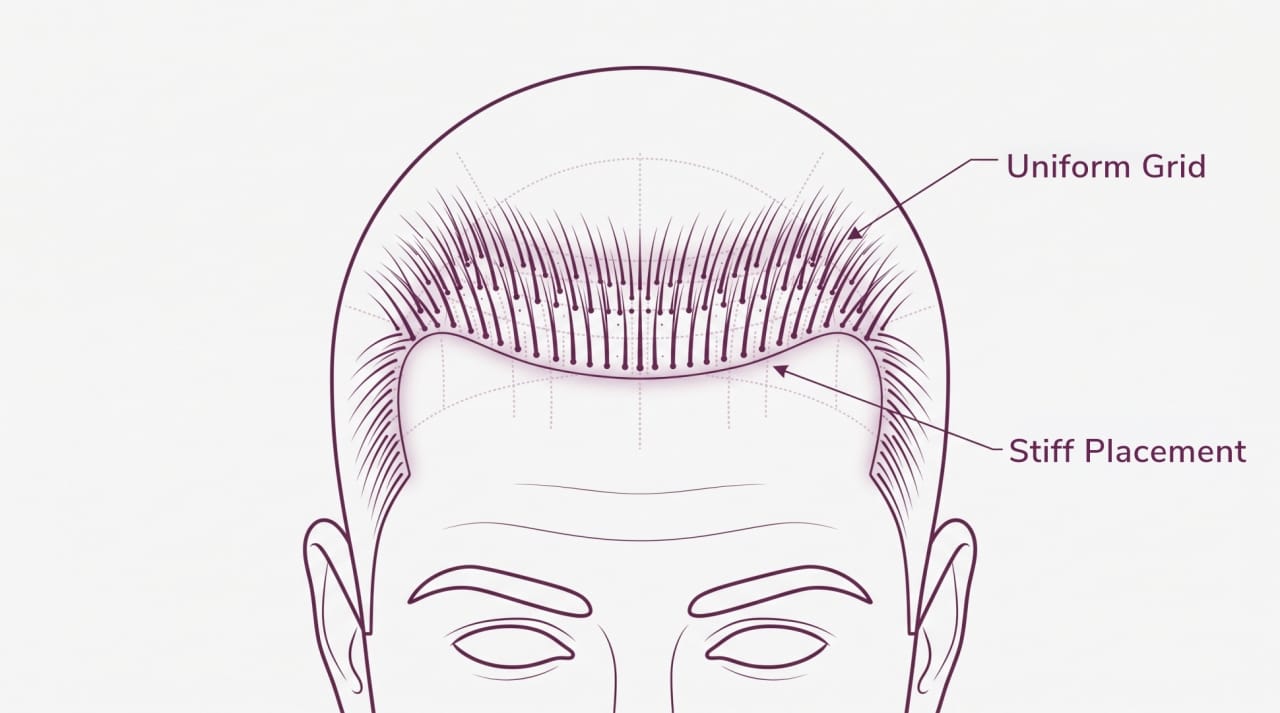
The word patients use is “pluggy.” Stiff. Doll-like. Planted. The hair sits on the scalp like it was installed rather than grown. Each follicle appears to have been placed with the same angle, the same spacing, the same mechanical uniformity, and the cumulative effect is a scalp that looks populated but not inhabited.
The grafts did their job. They survived the extraction, the handling, the implantation. They took root. They grew. And yet the result doesn’t look right.
The answer is almost never the grafts themselves. It is what was done with them.
What Natural Hair Actually Looks Like
Before I can explain what goes wrong in a pluggy transplant, I need to describe what goes right in a natural head of hair. Because natural hair is not what most people think it is.
Look closely at someone with a full, untouched scalp. Not at the overall impression, but at the architecture. What you will find is not order. It is organised chaos.
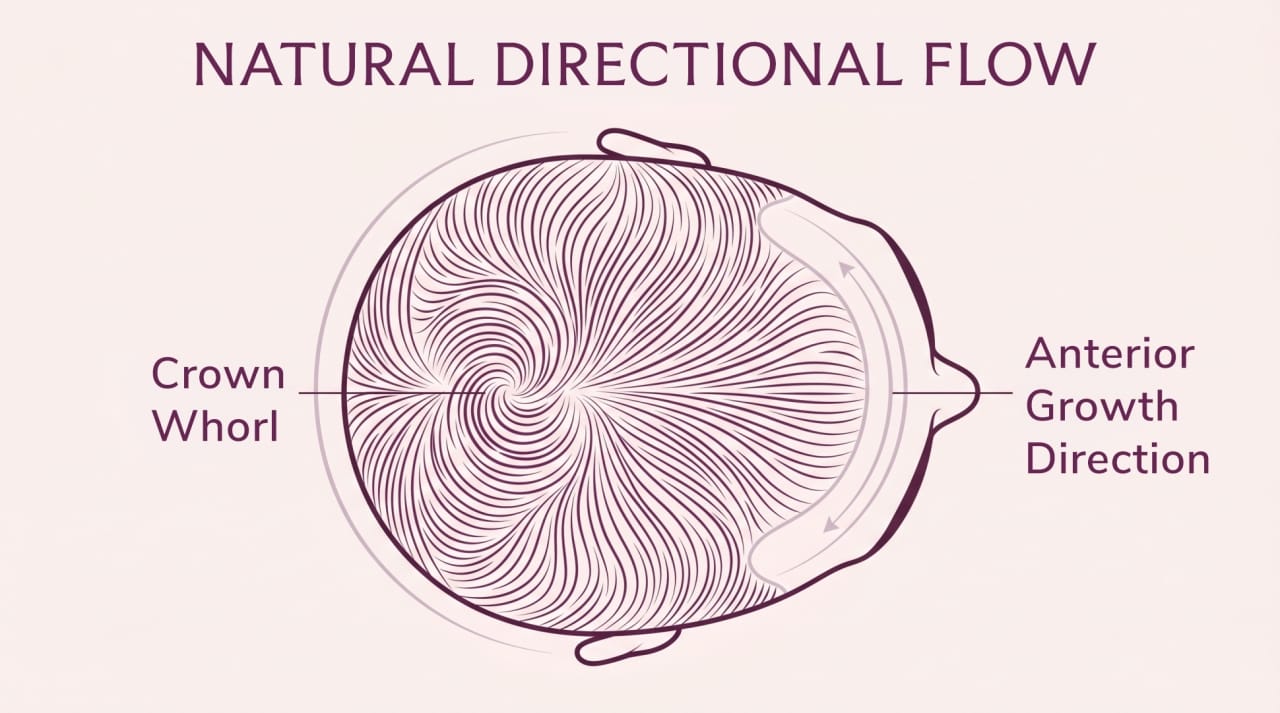
The angle of each hair varies across the scalp. At the frontal hairline, hairs emerge at an acute, almost flat angle, lying close to the skin. Move further back and the angle steepens. At the crown, the hairs radiate outward from a central whorl in a spiral pattern that is unique to every individual, as singular as a fingerprint.
The direction changes too. Hairs along the temporal line point forward and downward. Hairs at the mid-scalp point backward. The transition between these zones is not abrupt. It is a gradient, a slow rotational shift that unfolds over centimetres, not millimetres.
And then there is the matter of follicular unit composition. At the very front of the hairline, nature places single-hair follicular units. One hair, one follicle. Fine, soft, almost wispy. This creates a feathered, irregular leading edge that does not read as a line. It reads as a beginning. Behind this edge, two-hair and three-hair units increase in frequency, building density gradually rather than switching it on.
There is also variation in depth, in the curl of individual strands, in the subtle differences in calibre between one follicular unit and the next. None of this is random in the mathematical sense. It follows genetic programming. But the visual effect is randomness: a head of hair that appears to have no pattern because the pattern is too complex for the eye to decode at a glance.
This is what natural looks like. And this is precisely what a pluggy transplant fails to replicate.
Where the Plugginess Comes From
A pluggy transplant is not a graft failure. It is a placement failure. The grafts were viable. They grew. The follicular units were intact. The density on paper might even be impressive. But the way those grafts were seated into the scalp ignored the complexity I just described, and the scalp does not forgive the simplification.
There are several ways this happens, and they tend to compound each other.
Uniform angle. Every graft inserted at the same pitch, typically perpendicular or near-perpendicular to the scalp surface. Natural hair does not behave this way. It lies flatter at the front and steepens toward the back. When every graft stands at the same angle, the hair does not flow. It protrudes. Each strand catches light identically, casts shadow identically, and the collective effect is a field of identical soldiers rather than a living surface.
Uniform spacing. Grafts placed at equal intervals, like tiles on a floor. Natural hair is not evenly distributed. It clusters in some areas and gaps in others. It overlaps. The irregularity is what makes density look organic. Even spacing, paradoxically, makes hair appear thinner and more artificial than it is, because the eye detects the grid and reads it as construction.
Wrong units at the hairline. Multi-hair follicular units, doubles or triples, placed at the very front where nature uses singles. The result is a hairline that begins too abruptly, too densely, too definitively. There is no feathering, no transition, no softness. It starts like a wall rather than a suggestion.
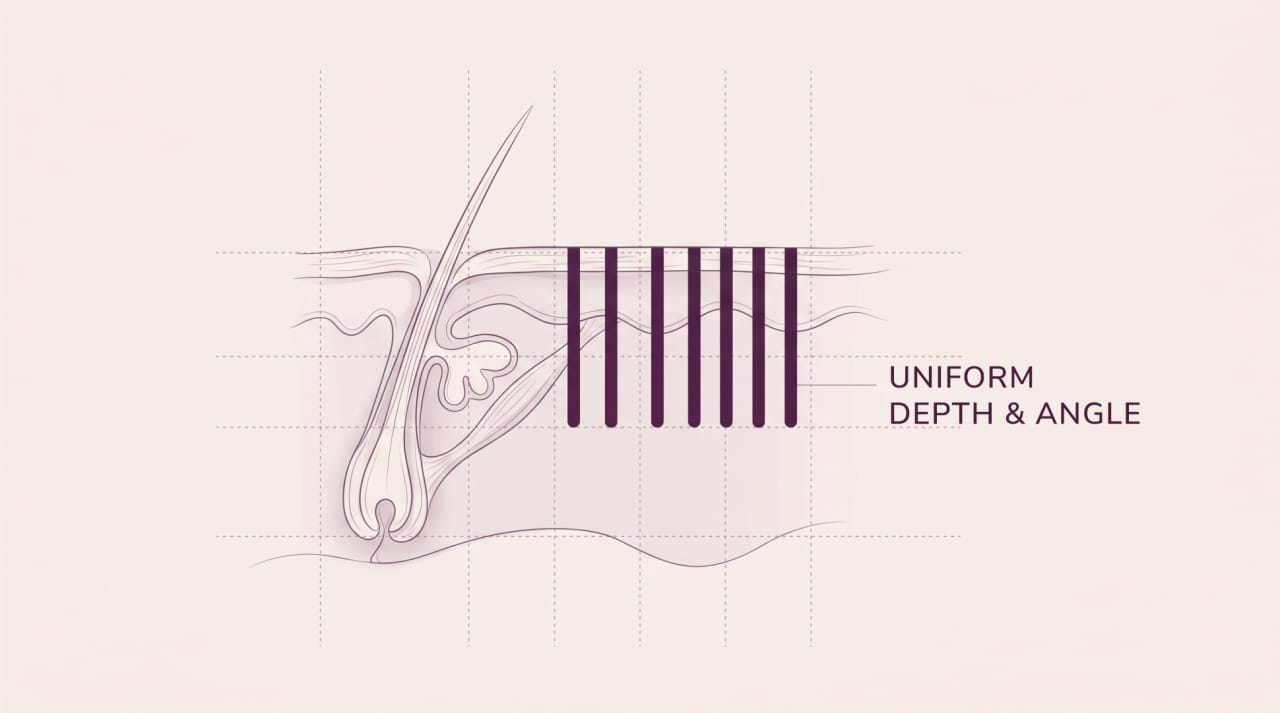
Uniform depth. All grafts seated at the same level in the dermis, when natural follicles sit at varying depths depending on their location and the number of hairs they carry. This produces a flat, one-dimensional plane of growth where there should be layering, texture, and visual depth.
Each of these errors alone produces a subtle wrongness. Combined, they produce the unmistakable look of a transplant that was executed rather than designed.
Why This Cannot Be Automated
There is a reason I am particular about this point, and it connects to something I see increasingly in the industry.
Motorised extraction tools, robotic assistance, and standardised implantation protocols have made hair transplantation faster and more accessible. In certain respects, this is progress. Faster extraction reduces the time grafts spend outside the body. Standardised handling protocols reduce specific categories of error.
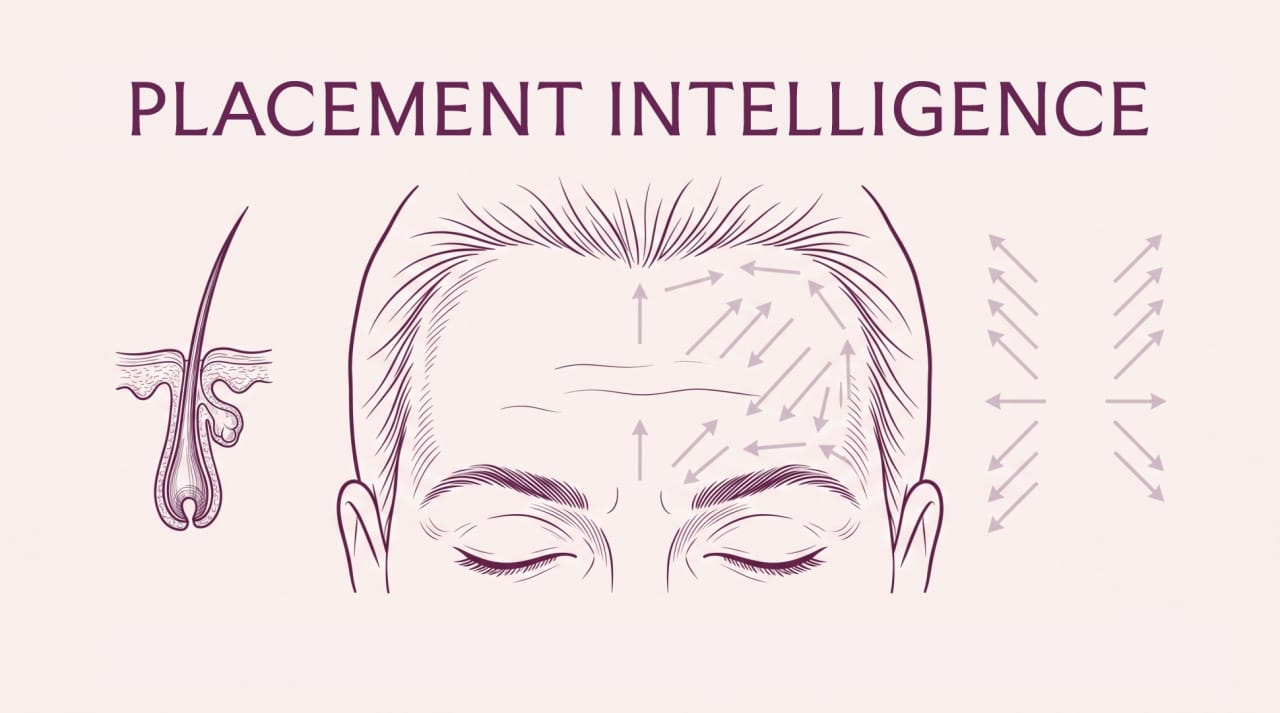
But what these systems cannot do is think about angle. They cannot modulate direction across a hairline the way a surgeon’s hand can, adjusting by fractions of a degree with each successive graft. They cannot decide that this particular spot needs a single-hair unit placed at 15 degrees while the spot three millimetres to its left needs a two-hair unit at 22 degrees. They cannot read the existing pattern of a patient’s remaining native hair and calibrate the transplanted zone to it so that the boundary between the two becomes invisible.
This is placement intelligence. It is not a protocol. It is not a setting on a device. It is the accumulated understanding of how natural hair organises itself, applied graft by graft, over thousands of individual decisions in a single session.
A session of 2,500 grafts means 2,500 individual decisions about angle, direction, depth, and unit selection. Each one informed by the decisions that preceded it and the ones that will follow. Each one contributing to the overall coherence of a result that will, if done well, look like nothing was done at all.
That is the job. And it is, irreducibly, a surgeon’s job.
The Difference Between Coverage and Believability
This is the distinction I return to most often when I think about hair transplant quality, because it captures the line between adequate work and exceptional work more precisely than any metric.
Coverage is quantitative. How many grafts per square centimetre. What percentage of the bald or thinning area is now populated. It is measurable, reportable, and easy to promise in a consultation. A clinic can guarantee coverage. They can deliver it. And on a strictly numerical level, they will have fulfilled their commitment.
Believability is something else entirely. It is the qualitative measure of whether the result looks like hair that grew there on its own. Whether a barber can cut it without pausing. Whether a person standing close to you has no reason to look twice. Whether you can run your fingers through it and feel the natural variation in direction and texture that belongs to an untouched scalp.
Coverage without believability is density without design. It is the pluggy transplant in its purest form. The grafts grew. The area is filled. And something is wrong.
Believability is what happens when the surgeon understands that a hair transplant is not a planting exercise. It is a mimicry exercise. The goal is not to fill a space. The goal is to recreate the organised chaos that nature spent millennia perfecting, using a fraction of the original follicle count, in a way that the eye accepts without question.
That is not a technical problem solved by technology. It is an artistic problem, solved with surgical tools.
What to Ask Before You Book
If you are researching hair transplants, do not ask only how many grafts a surgeon places. Ask how they place them. Ask about angulation. Ask about unit selection at the hairline. Ask to see results at twelve and eighteen months where the transplant is undetectable, not where the density is impressive.
The grafts will do their job. They will grow. The question that determines everything is whether they will grow into a pattern that looks like it belongs to you, or into a pattern that announces its own construction.
That question is answered not by the grafts. It is answered by the hand and the eye that placed them.
If you want a transplant designed for believability, not just coverage, you are welcome at Freyea Aesthetics, South Delhi.
Dr. Ashutosh Misra
Founder, Freyea Aesthetics | South Delhi
MCh (Plastic & Reconstructive Surgery), MS (General Surgery), MBBS
25+ years of surgical experience
freyea.com