What Actually Happens in a Breast Reduction Consultation

There is a question women want to ask before booking a breast reduction consultation and very rarely do.
It is not about cost, or scars, or recovery. Those get asked. The unasked one is simpler and more immediate: what is going to happen to me in that room?
Will I have to undress. Will there be someone else present. How long does the examination take. Will I be photographed. Is it going to be uncomfortable, or humiliating, or clinical in the way that makes you feel like a specimen rather than a person.
I have come to believe this unasked question delays more women than any other single factor. Not the surgery itself. The appointment.
So here is the entire consultation, described in order, with nothing left vague.
Before You Arrive
A few things make the appointment considerably more useful.
Bring a list of your medications and supplements, including anything taken occasionally. Bring any previous breast imaging you have had, mammogram or ultrasound, with the reports rather than just the films. Bring a record of any investigations or treatments you have had for the symptoms, particularly physiotherapy notes or orthopaedic opinions, because those help establish how long this has been going on and what has already been tried.
Know your family history if you can, specifically any breast or ovarian cancer in close relatives, and at what age.
Wear something you can change out of easily. You do not need to bring a target cup size, and if you have one in mind that is fine, but it is not the unit we will actually be planning in.
If you would like someone with you, bring them. A partner, a sister, a friend. Many women prefer to attend alone and that is equally fine. There is no correct version of this.
The Conversation Comes First
Nothing physical happens for the first part of the appointment. We sit and talk, fully clothed, and the questions are mostly not about appearance.
I ask what your breasts are stopping you from doing comfortably. Exercise, sleep, clothing, posture, carrying things, working at a desk for long periods. I ask about pain and where it sits, whether it is neck, upper back, shoulders, or all three. I ask about grooving where the bra straps bear weight, and whether the skin there has changed. I ask about numbness or tingling in the hands, which more women report than expect to be asked.
I ask about the fold beneath the breast, and specifically about rash, because in Delhi this is seasonal and significant and most women have simply accepted it as a fact of April through September.
Then history. Your general health, medications, previous surgery, smoking, weight and whether it has been stable. Your family history. Whether you have had children, whether you plan to, and how you feel about breastfeeding, which is a conversation I will come back to.
This part usually takes longer than the examination.
The Examination, Described Properly
This is the part women want described, so let me be specific.
You will be asked to undress to the waist behind a screen or in an adjoining space, and you will be given a gown. A trained female chaperone is present for the examination as a matter of routine, not on request. If you would prefer someone you brought with you to be present as well, that is entirely acceptable.
You will be examined standing for part of it, because breast position and the effect of weight can only be assessed upright, and lying down for part of it, because the tissue itself is examined differently.
I examine both breasts for any lump or abnormality, and I examine the axilla. This is a clinical breast examination and it is not optional, because the operation removes tissue and anything present should be identified beforehand.
Then I measure. This is the part that surprises people, because it is done with a tape measure and it is unglamorous and fairly quick.
What gets measured and why
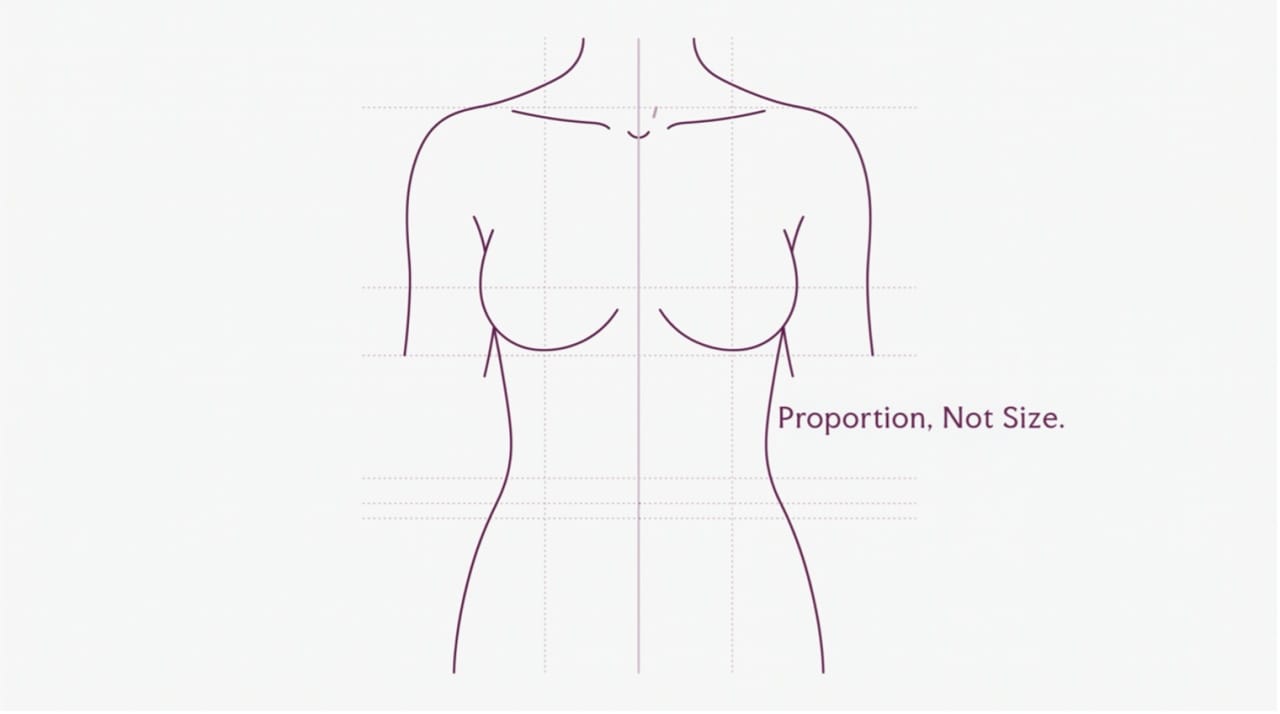
The distance from the sternal notch, the hollow at the base of your throat, to each nipple. In a woman without significant breast enlargement this is commonly in the region of nineteen to twenty one centimetres. In macromastia it is frequently considerably more, and the figure tells me how far the nipple has descended and therefore how far it will need to travel.
The distance from each nipple to the fold beneath the breast, which tells me about skin excess and how the lower pole is behaving.
The base width of the breast across the chest wall, which constrains what shape is achievable.
The degree of ptosis, meaning where the nipple sits relative to the fold, which is graded and determines the technique.
Any asymmetry between the two sides, which exists to some degree in almost everybody and which is documented before surgery precisely so that it can be discussed rather than discovered afterwards.
And skin quality, including striae and elasticity, which affects how the skin will behave after tissue is removed.
The whole examination takes about ten minutes. It is matter of fact, it is explained as it happens, and you can stop it at any point.
Why We Plan in Grams, Not Cup Sizes
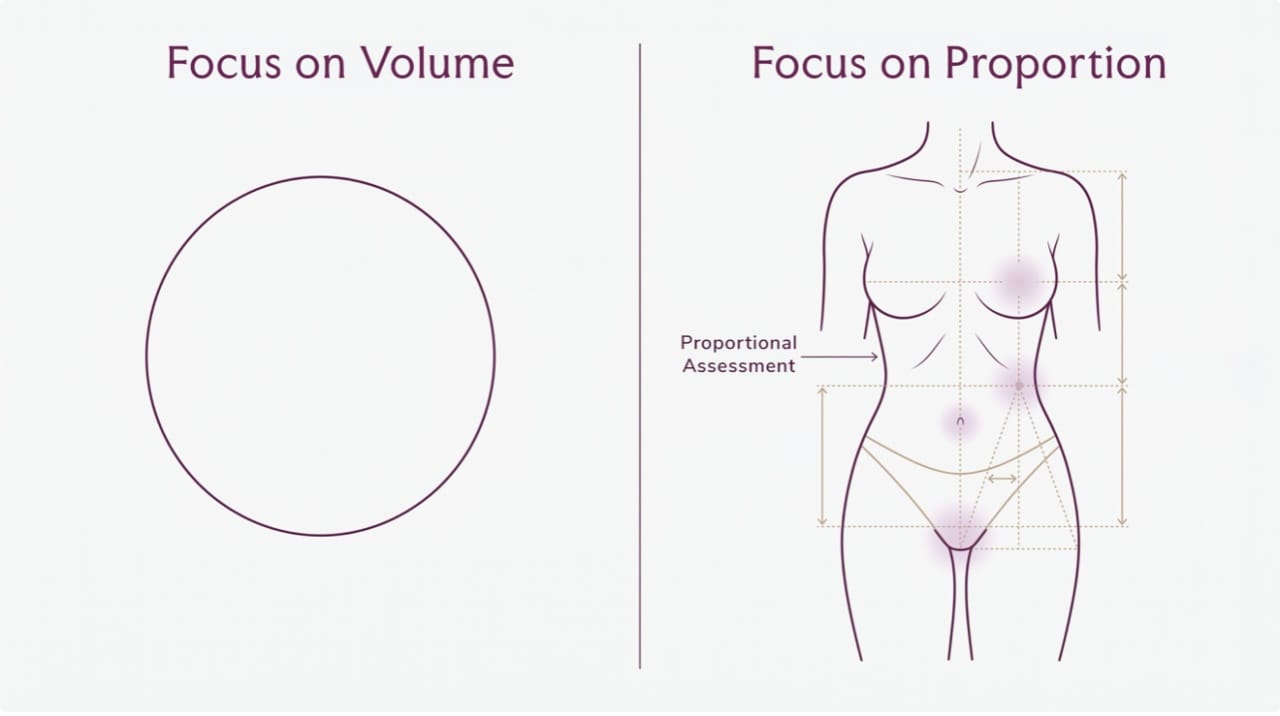
At some point in the consultation I will give you an estimated resection weight, expressed in grams per side. Patients often find this an odd unit and want to convert it into a cup size, so it is worth explaining why we do not plan that way.
Cup sizing is not a standardised measurement. It varies between brands, between countries, and between manufacturing runs within the same brand. A woman can wear three different sizes across three shops in the same afternoon. It also describes a relationship between two circumferences rather than a volume, which means the same cup letter means entirely different things on different band sizes.
Grams of tissue removed is a fixed, verifiable quantity. It relates directly to operating time, to technique selection, to the likelihood of needing an overnight stay, and to the cost of the operation.
What I can tell you is roughly where you will end up in proportion to your frame, and I will describe that in terms of your body rather than in terms of a letter. If you have a specific size in mind we will talk about whether it is realistic, and occasionally the honest answer is that going smaller than a certain point on your particular frame will produce a result that looks disproportionate rather than better.
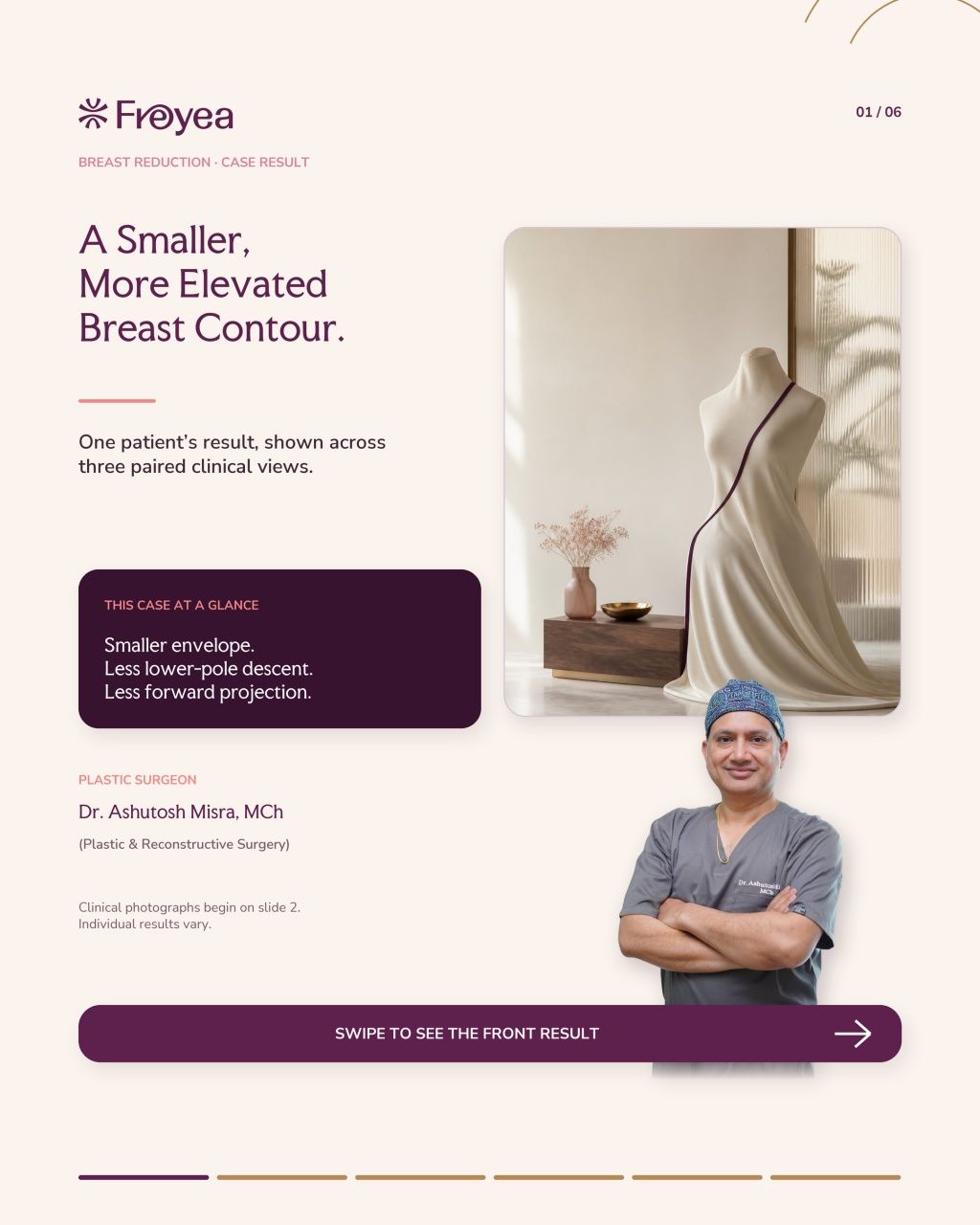
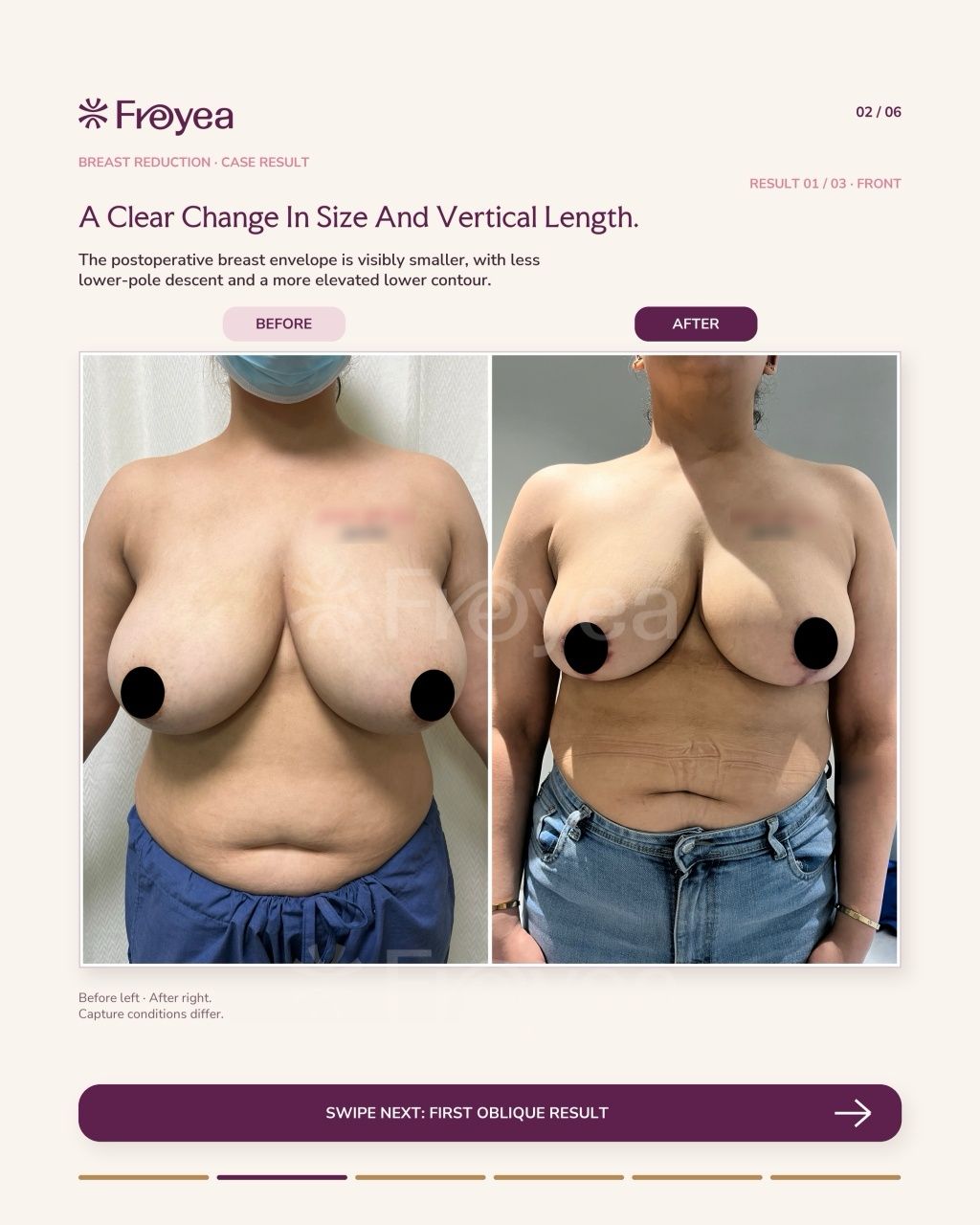
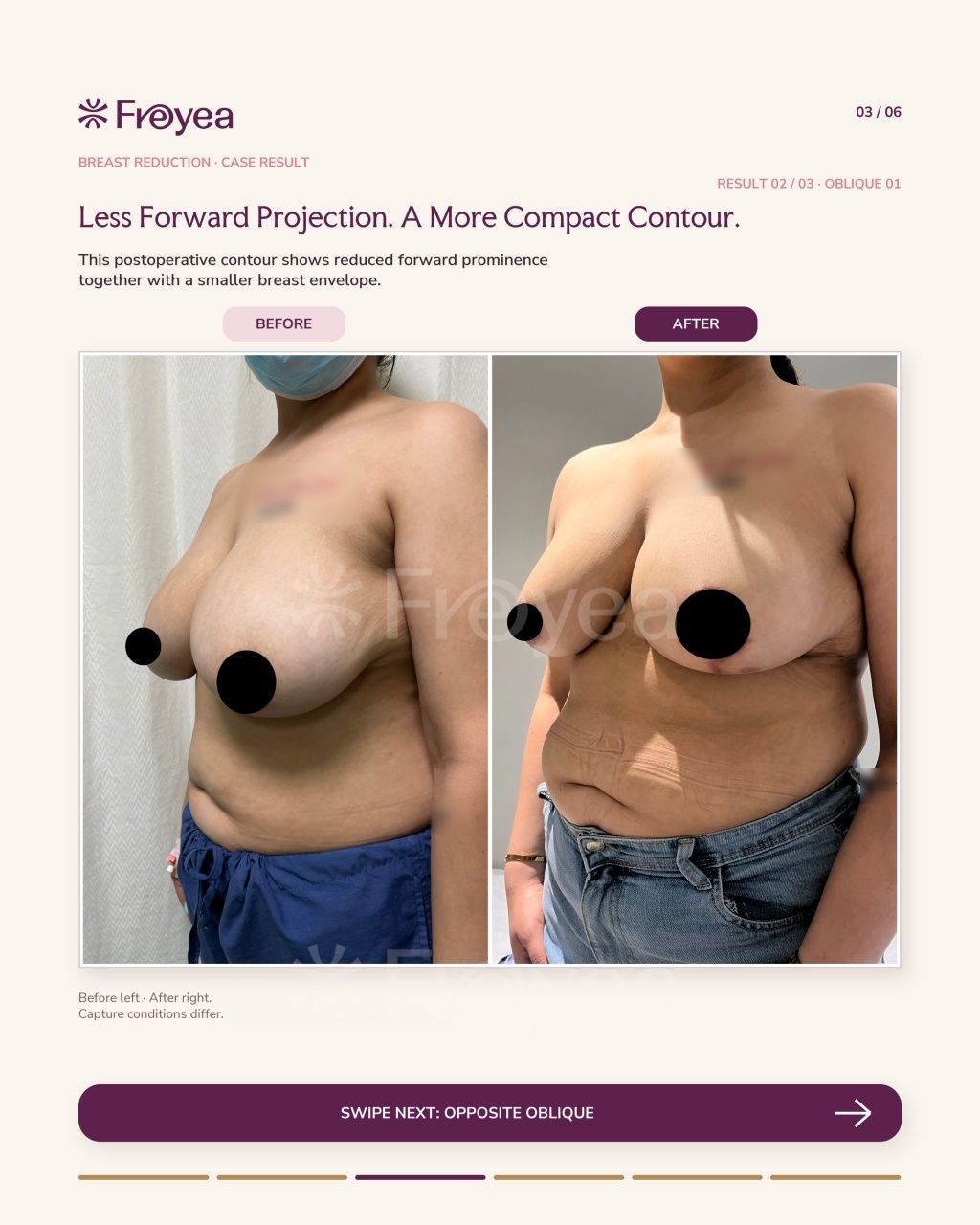
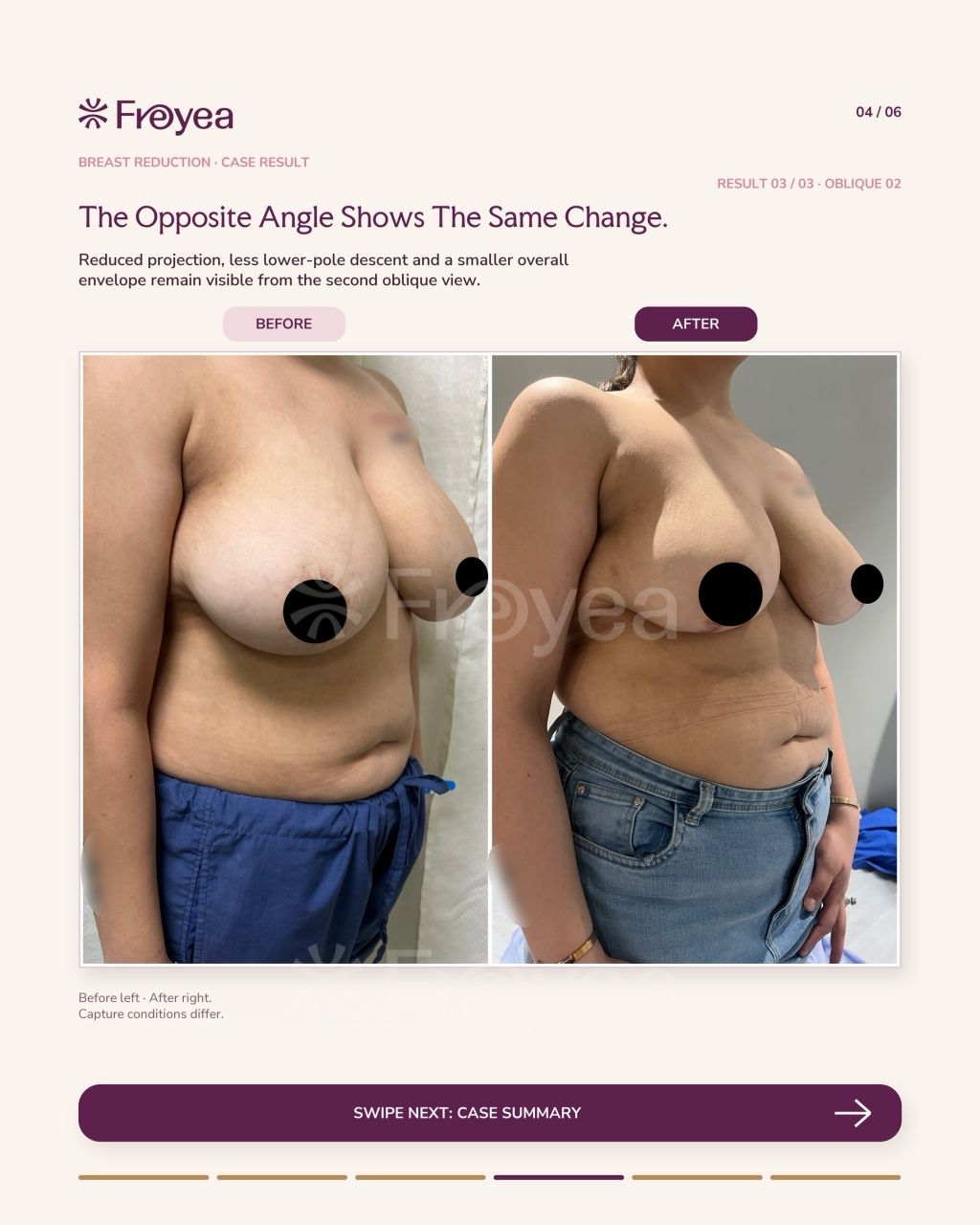
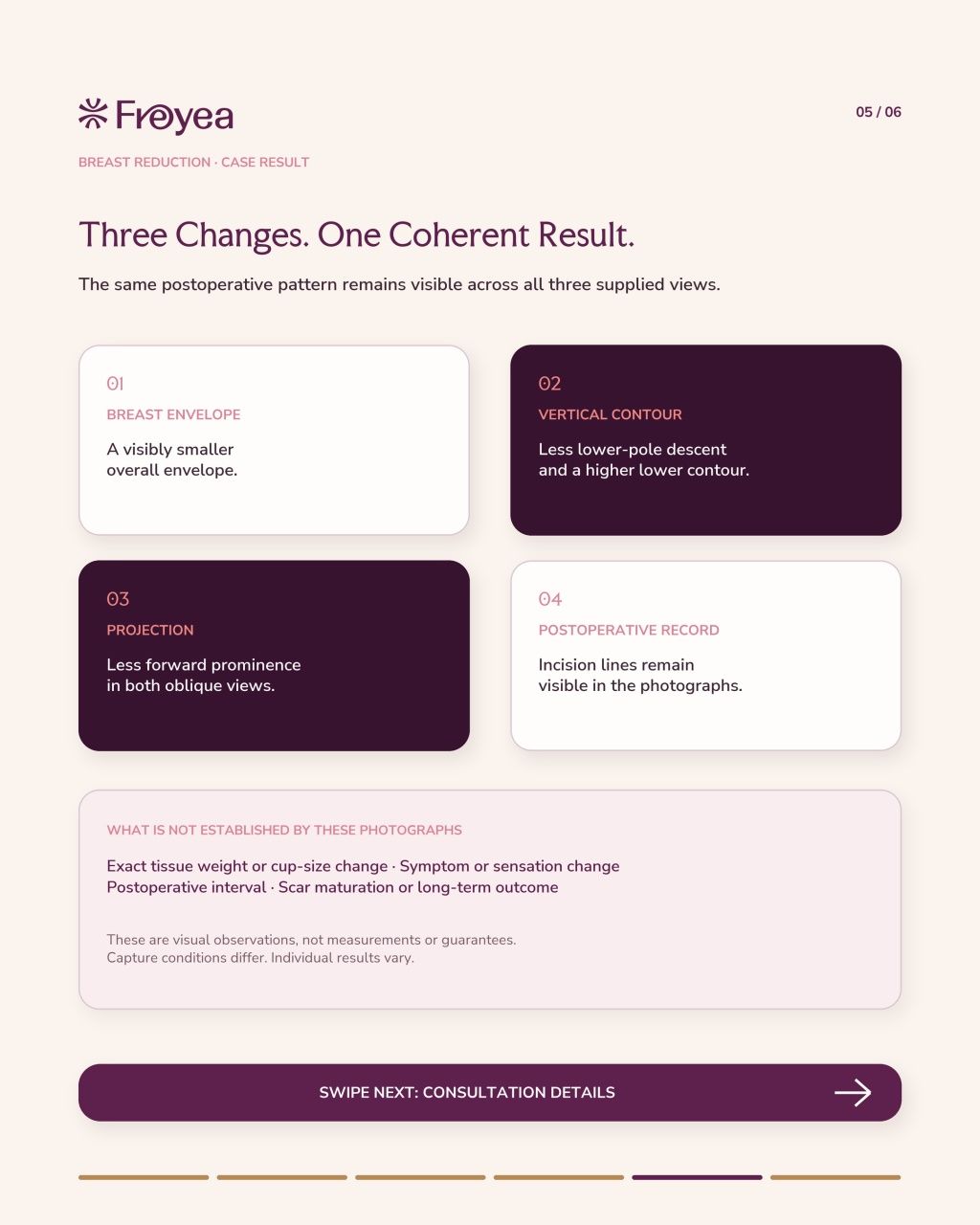
Clinical results: patient before and after breast reduction contour and proportion. Tap any image to expand.
Photographs
Clinical photographs are part of a proper breast reduction assessment, and I want to explain what they are for and how they are handled.
They are taken in standardised views, front and both sides, from the collarbone to the waist, with the face excluded. They exist for surgical planning, for comparison at follow-up, and as part of the medical record. Memory is unreliable in this area, and at your six month review the photographs are the only accurate account of where you started.
They are taken with your explicit consent, and consent for clinical records is entirely separate from consent for any other use. Nothing goes anywhere near marketing, teaching, or publication unless you sign a separate and specific consent for that, and declining it changes nothing about your care. You can decline photography altogether, though it does make follow-up comparison harder and I will say so.
If this part is difficult for you, say so. It can be arranged with the chaperone only, and it takes under two minutes.
Imaging
Depending on your age and history, breast imaging may be needed before surgery.
For women over forty, or at any age with a family history of breast cancer or a palpable abnormality, a mammogram or ultrasound before reduction is appropriate. It establishes a baseline for future screening, which matters because breast tissue looks different on imaging after surgery, and occasionally it identifies something that changes the plan entirely.
If you have had imaging recently, bring the report. If you need it, we will arrange it before scheduling anything.
The Technique Conversation
Once I have examined and measured you, I can tell you which technique your anatomy requires and why.
This covers the pedicle, meaning the column of tissue that keeps the nipple attached to its blood supply and nerve supply while tissue around it is removed, and the scar pattern, which will either be a vertical lollipop shape or the anchor shape that adds a horizontal scar along the fold.
I will show you where the scars will sit on your own body rather than on a diagram. I will tell you what they look like at three months, which is when they are at their most red and raised and when women most often worry, and what they look like at a year.
This is also where the trade-offs get stated plainly rather than glossed. Scars are permanent. Sensation can change and is usually temporary but occasionally is not. Recovery takes time and the compression garment is not negotiable.
The Family Planning Question
I will ask whether you have completed your family, and if not, how you feel about breastfeeding.
This is not a gatekeeping question and it is not a suggestion that you should wait. It is a planning question, because modern pedicle techniques preserve a substantial portion of the ductal system and many women breastfeed successfully afterwards, but capacity may be reduced and success cannot be guaranteed. In very large reductions requiring a free nipple graft, breastfeeding is essentially eliminated.
Some women hear this and proceed, entirely reasonably, having weighed it. Others decide to wait, which is equally reasonable. What I want to avoid is a woman finding out afterwards that this was a factor nobody mentioned.
What You Leave With
By the end of the appointment you should have several things:
- An estimated resection weight per side.
- The technique your anatomy requires and the reason for it.
- The scar pattern, indicated on your own body.
- A realistic description of the outcome in proportion to your frame.
- A clear account of the trade-offs.
- A recovery timeline that takes your actual work and home situation into account.
- A written quote with the components itemised.
- And any investigations you need before scheduling.
You should not leave with a booking under pressure. If you want to think about it for three months, think about it for three months. Almost nothing about this operation is urgent, and a decision made under time pressure in a consultation room is not a decision I want attached to a permanent result.
Most women I operate on have been carrying this for fifteen to thirty years. Another few weeks of consideration changes nothing except the quality of the decision.
Consultations in East of Kailash, South Delhi
We see patients for breast reduction at our clinic in East of Kailash, a short distance from Kailash Colony metro on the Violet Line, and straightforward to reach from Greater Kailash I and II, Defence Colony, Lajpat Nagar, CR Park, Kalkaji, Jangpura, Nehru Place, and Sarita Vihar.
Consultations are private and unhurried. A female chaperone is present for every examination as routine. If you would prefer to discuss everything first and defer the examination to a second appointment, that can be arranged and is more common than you might think.
Freyea Aesthetics
F-46, East of Kailash
New Delhi 110065, India
Dr. Ashutosh Misra, MCh (Plastic & Reconstructive Surgery), MS, MBBS
freyea.com