What Breast Reduction Costs in Delhi, and Why Quotes Vary So Much

She had two quotes. One was eighty five thousand rupees. The other was two lakh forty.
Same woman. Same breasts. Same operation, at least according to both documents, each of which used the phrase reduction mammaplasty. She had been to both consultations in the same week and she arrived at mine wanting to know, reasonably, whether the expensive one was a swindle or the cheap one was a risk.
The honest answer is that it was neither, and that the four-fold spread across this market in Delhi is mostly explicable once you know what to look at. But almost nothing in either document would have helped her work it out on her own, because quotes in this field are written to be accepted rather than to be compared.
So this piece is the comparison framework. If you are looking at breast reduction anywhere in Delhi, this is what the numbers are actually made of.
The Range, Honestly

Quoted prices for breast reduction in Delhi span from around seventy five thousand rupees at the lowest end to well over three lakh at the top. Most established practices with an MCh qualified plastic surgeon quote somewhere between one lakh twenty and two lakh fifty, with complex cases above that.
Some aggregator platforms publish technique-based ranges, typically placing a liposuction-only reduction between sixty thousand and one lakh, a vertical or lollipop reduction between ninety thousand and one lakh thirty, and an anchor pattern reduction between ninety five thousand and one lakh fifty. These figures are a reasonable indication of the lower half of the market, though they tend to represent the surgical fee in a package hospital setting rather than a complete cost.
A spread this wide in a single city is not evidence of dishonesty. It reflects genuine differences in what is being done, by whom, where, and what is included. The problem is that none of those differences appear on the quote.
How Much Tissue Has to Come Out
This is the largest single driver of cost and the one patients almost never think about.
Breast reduction is planned in grams of resection per side, not in cup sizes. A woman requiring three hundred grams removed from each side and a woman requiring eleven hundred grams are having operations of substantially different duration, complexity, and risk.
Longer operating time means more anaesthesia, more theatre time, more staff hours, and a greater likelihood of needing an overnight stay rather than a same-day discharge. It also means a more demanding reconstruction, because the larger the reduction, the more the remaining tissue has to be reorganised and the further the nipple has to travel to its new position.
This is why a quote produced before you have been measured and examined is not a real quote. It is a starting price attached to your enquiry. The same clinic will produce different numbers for two women who describe themselves identically over the phone, once someone has actually assessed them.
Technique Is Determined by Anatomy, Not by Preference
Patients sometimes arrive believing that technique is a menu item, and that choosing a cheaper technique is a way to control cost. It is not, in most cases, a choice.
A liposuction-only reduction removes fat and does nothing about glandular tissue, skin excess, or nipple position. It suits a narrow group of patients whose breasts are predominantly fatty, whose skin has good elasticity, and whose nipple sits at an acceptable height. For most women presenting with genuine macromastia it is not an appropriate operation, and choosing it because it is cheaper produces a smaller breast with the same shape problem and the same low nipple.
A vertical or lollipop pattern suits moderate reductions where the skin will retract adequately over the reshaped breast.
An anchor or Wise pattern is required for larger reductions and for significant skin excess. It takes longer, it involves more tissue rearrangement, and it costs more because it is more work.
If one clinic quotes you a vertical technique and another quotes an anchor for the same breasts, one of them has assessed you differently, and that is worth asking about directly. The cheaper technique is not a saving if it is the wrong operation.
Who Is Giving the Anaesthetic
Breast reduction is performed under general anaesthesia. This is not a procedure that can be done under local infiltration, and any suggestion otherwise should end the conversation.
What varies is who administers it and what monitoring is in place. A dedicated consultant anaesthetist present throughout, with full monitoring and recovery provision, costs more than a more minimal arrangement. This difference is real, it is significant, and it is the single cost variable most closely connected to your safety.
Ask for the anaesthetist by name and qualification. Ask whether they remain present for the whole operation. Ask what monitoring is used and what the recovery arrangement is. These are ordinary questions and any properly run practice will answer them without defensiveness.
Where the Operation Happens
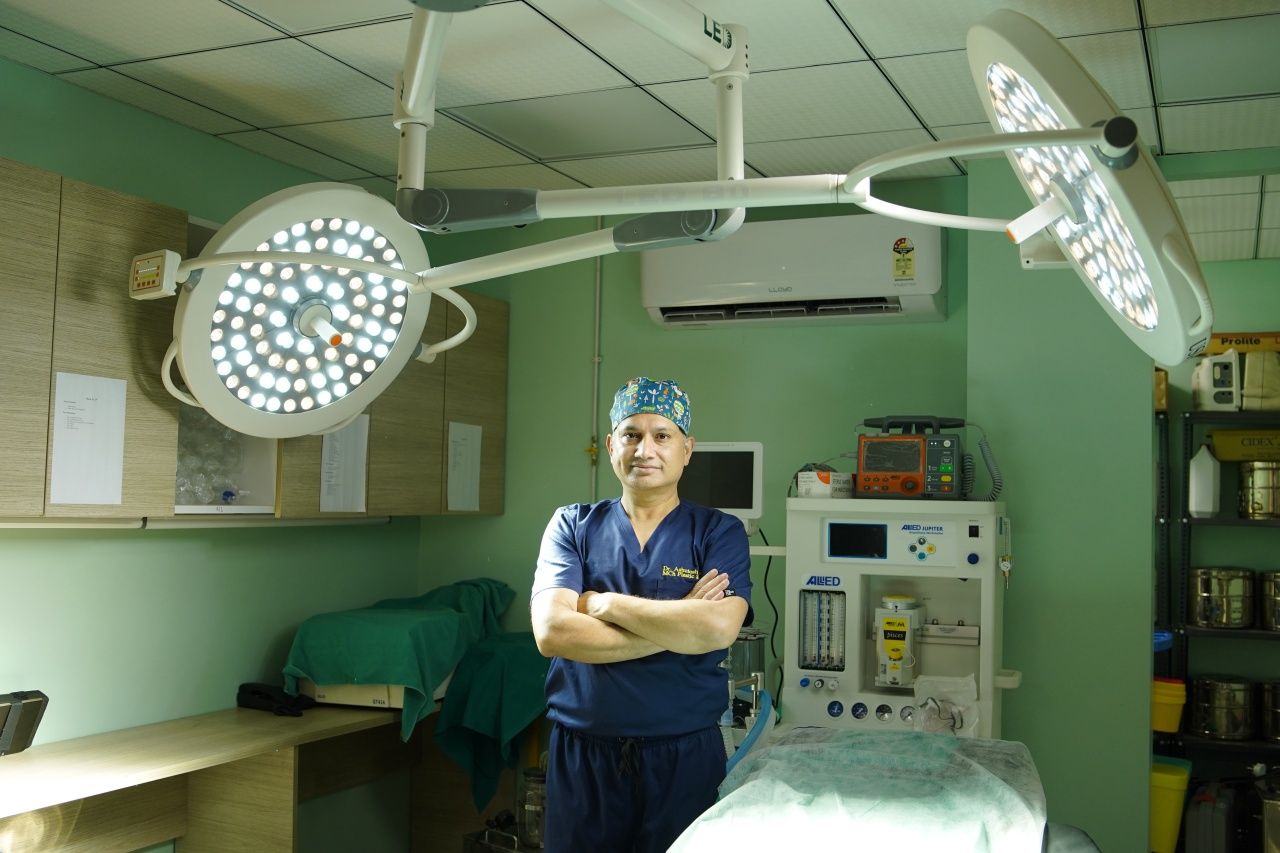
A licensed operating theatre with sterile air handling, emergency provision, resuscitation equipment, and an arrangement for transfer if something goes wrong costs considerably more to run than a procedure room.
You should know which one you are being booked into. You should also know whether an overnight stay is included, because a two to four hour general anaesthetic with drains sometimes warrants observation, and a quote built on same-day discharge will increase if that turns out not to be appropriate for you.
Who Is Operating

Breast reduction is a plastic surgery operation. It is performed by surgeons who hold formal plastic surgery training, meaning an MCh or DNB in Plastic and Reconstructive Surgery, and it does not sit within the scope of any other specialty.
That is not a technicality. The operation involves preserving the blood supply and the nerve supply to the nipple areolar complex through a pedicle while removing tissue around it, closing a wound that carries meaningful tension, and producing a symmetrical result across two sides operated independently. It is reconstructive work, and it draws on judgement that plastic surgery training exists specifically to build.
You are entitled to ask for your surgeon's qualification and registration number, and to verify it on the Delhi Medical Council or National Medical Commission register. The surgeon's fee is a component of what you are paying, and experience with this particular operation is a legitimate reason for it to be higher.
The Line Items That Disappear
Read every quote for what is absent rather than what is listed.
Pre-operative investigations
Blood work, and depending on your age and history, breast imaging. These are frequently billed separately.
Breast imaging before surgery
For women over forty, or at any age with a family history or a palpable abnormality, a mammogram or ultrasound before reduction is appropriate practice. It establishes a baseline and it occasionally changes the plan entirely. If nobody has mentioned imaging and you are in that group, ask why.
Histopathology
This one matters more than any other omitted item, and it is the one almost nobody asks about.
Tissue removed during a breast reduction should be sent for histopathological examination. Reduction specimens occasionally contain unexpected pathology that nobody was looking for, in women with no symptoms and no imaging findings. Sending the specimen is standard practice, it costs money, and it is a corner that can be quietly cut. Ask explicitly whether histopathology is included and whether you will receive the report.
The surgical bra
You will need a supportive compression garment worn continuously for four to six weeks, and realistically you will want two so one can be washed. Frequently not included.
Medication and dressings
Analgesia, antibiotics if indicated, and dressing changes over the first two to three weeks.
Follow-up reviews
Ask how many are included and over what period. Proper follow-up for this operation runs to at least a year, because scar maturation and final shape both continue well beyond the first few months.
Revision policy
Ask what happens if there is asymmetry requiring correction, or a dog ear at the end of the horizontal scar, or delayed healing at the T junction that needs a small procedure. Ask for the policy in writing before you pay a deposit. A practice that has thought about this will have a written answer.
Insurance in India, Plainly
Breast reduction is generally classified as cosmetic by Indian health insurers and is therefore usually not covered.
There is a partial exception. Where the procedure is medically indicated, meaning documented physical symptoms such as chronic back and shoulder pain attributable to breast weight, some policies will consider coverage. In practice this requires documentation built over time: a record of symptoms, physiotherapy attempted, orthopaedic or physician notes, and a clear clinical case.
I would not advise anyone to plan around insurance for this operation. If you intend to pursue it, start the documentation early and speak directly to your insurer before you book anything, because retrospective claims in this category rarely succeed.
What a Very Cheap Quote Is Usually Missing
When a quote sits substantially below the range for a comparable operation, it is usually one of a small number of things.
It may be a starting price for the smallest reduction the practice performs, which will rise once you are assessed. It may exclude anaesthesia, facility charges, investigations, garments, or follow-up, so that the final bill assembles itself in stages. It may be for a liposuction-only reduction that is not the right operation for you. It may reflect a procedure room rather than a licensed theatre. It may reflect a surgeon without plastic surgery training. Or the practice may simply be operating at higher volume with less time per case.
Several of those are acceptable if you know about them and accept them knowingly. None of them are acceptable if you find out afterwards.
How to Compare Two Quotes Properly
Ask each clinic the same set of questions and compare the answers rather than the totals:
- What is the estimated resection weight per side?
- What technique, and why that one for my anatomy?
- Who is the surgeon, what is their qualification and registration number, and will they perform the whole operation?
- Who is the anaesthetist?
- Is this a licensed operating theatre?
- Is an overnight stay included, and what happens if I need one?
- Is histopathology included?
- Is breast imaging included or required?
- How many follow-ups, over what period?
- Is the surgical bra included?
- What is the written revision policy?
Once you have those answers side by side, the price difference usually explains itself in about two minutes, and the decision becomes a real one rather than a guess.
The cheapest quote is not automatically wrong and the most expensive is not automatically better. What matters is knowing what each number is buying, and then deciding whether that difference is worth it to you.
Consultations in East of Kailash, South Delhi
We assess and quote for breast reduction at our clinic in East of Kailash, a short distance from Kailash Colony metro on the Violet Line, and easily reached from Greater Kailash I and II, Defence Colony, Lajpat Nagar, CR Park, Kalkaji, Jangpura, Nehru Place, and Sarita Vihar.
We do not quote before an examination, because a number produced without measuring you is not information. If you already hold quotes from elsewhere, bring them. Reading them together is often more useful than adding a third.
Freyea Aesthetics
F-46, East of Kailash
New Delhi 110065, India
Dr. Ashutosh Misra, MCh (Plastic & Reconstructive Surgery), MS, MBBS
freyea.com