Tummy Tuck in Delhi: Why Core Work Will Never Fix a Lower Belly
She lifted her shirt and showed me something I see several times a month.
Above the navel, a flat abdomen with visible definition. She trains four days a week and has done for years. Below the navel, a soft rounded bulge that sits there regardless of what she eats or how hard she works. The two halves of her abdomen look like they belong to different people.
She has been told, by two trainers and one physician, that she needs to work harder on her core. She has done thousands of crunches. The bulge has not moved, and she has started to suspect that something is wrong with her.
Nothing is wrong with her. She has a structural problem that core work cannot reach, and in her case the core work she was prescribed has probably been making it slightly worse.
What Is Actually Happening Under the Skin
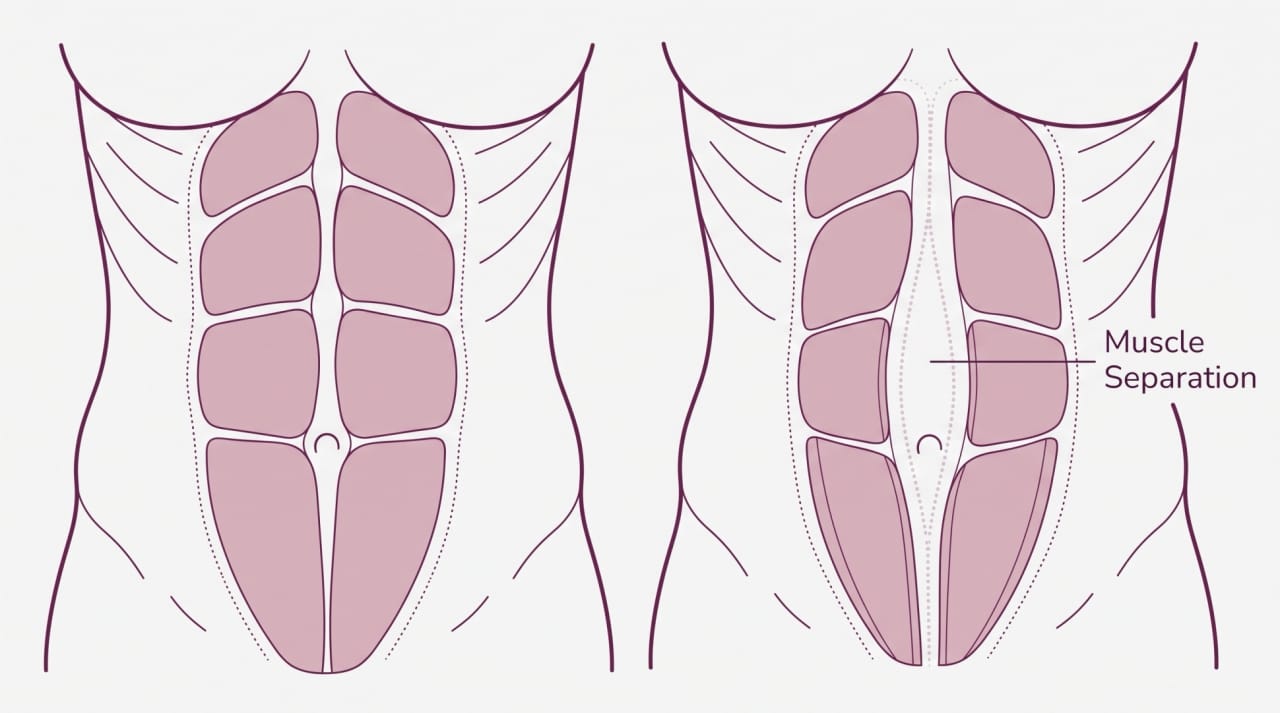
The two vertical columns of your abdominal muscle, the rectus abdominis, meet in the midline at a band of fibrous tissue called the linea alba. In an undisturbed abdomen these two columns sit close together, and that midline band holds them in place.
Pregnancy stretches it. Hormonal changes soften connective tissue to allow the pelvis and abdomen to accommodate a growing uterus, and mechanical load does the rest. The linea alba widens and the two muscle columns separate. This is diastasis recti, and in late pregnancy it affects the large majority of women.
For many, it narrows on its own in the months after delivery. For a substantial number, it does not. Once roughly a year has passed without closure, the separation is generally structural rather than temporary, and it is unlikely to resolve by itself.
What you are left with is a midline that no longer holds. The abdominal wall still works, but it has lost its central anchor, and the contents behind it push forward into the gap. That is the bulge. It is not fat sitting on top of the muscle. It is the abdominal wall itself failing to contain what sits behind it.
This is why the pattern is so characteristic. The upper abdomen can look excellent, because the separation is usually widest at and below the navel. The lower abdomen protrudes. And because the problem is mechanical rather than metabolic, body fat percentage has almost no bearing on it.
The Test You Can Do Yourself
Lie on your back with your knees bent and feet flat. Place two or three fingers flat across your midline just above the navel. Lift your head and shoulders slightly off the floor, as though starting a crunch, and press gently down into the midline.
If your fingers sink into a soft gap between two firm ridges of muscle, that gap is the separation. Measure it in finger widths. Then repeat at the navel and a few centimetres below it, because the width is rarely uniform and the widest point is usually at or just below the umbilicus.
There is a second sign that is easier to see than to feel. As you lift your head, look at your midline. If a ridge rises up along the centre of your abdomen, a narrow peak running vertically, that is coning. It means the pressure of the contraction is pushing outward through a midline that cannot resist it.
A separation of roughly two finger widths or more, persisting more than a year after delivery, is worth having assessed properly. In clinic I measure it directly and can confirm with ultrasound where there is any doubt. I also check for an umbilical hernia, which frequently accompanies diastasis and which changes the plan if present.
The whole examination takes under two minutes. That is the frustrating part of this condition. It is trivially easy to diagnose and almost nobody looks for it.
Why Crunches Can Make It Worse

This is the part that tends to land hardest, because it means the effort was not just wasted but counterproductive.
A traditional crunch or sit-up raises pressure inside the abdominal cavity and directs force forward against the midline. In an intact abdomen that is fine, because the linea alba resists it. In a separated one there is nothing in the middle to push against, so the pressure travels outward through the gap. That is the coning you saw in the test above, and repeated over months it can widen the separation rather than close it.
The same applies to full planks held poorly, to heavy loaded work without adequate bracing, and to anything that produces visible doming along the midline.
What does help is deep core work, specifically the transverse abdominis, which wraps the abdomen horizontally and functions more like a corset than a flexor. A good physiotherapist working specifically on postpartum abdominal rehabilitation can improve function meaningfully, reduce associated back pain, and in mild cases narrow the gap somewhat.
I recommend this to every patient before surgery, and some improve enough that they decide against an operation. But I want to be honest about the ceiling. Physiotherapy strengthens the muscles on either side of a gap. It does not reattach them. Where the separation is wide and the midline tissue has been stretched past its capacity to recoil, no exercise programme will close it, and a woman who has been told otherwise has been given false hope dressed as encouragement.
What the Repair Actually Involves
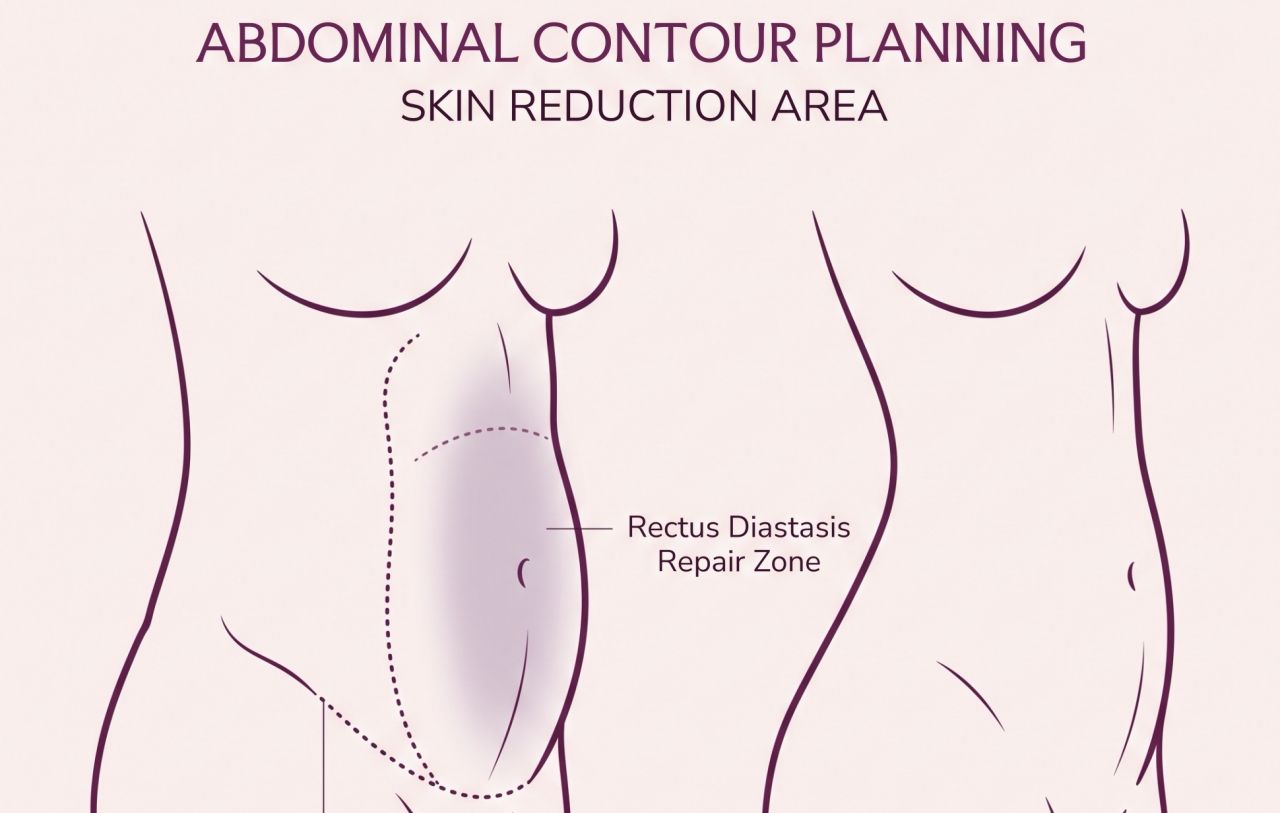
Correcting diastasis is a muscle operation. This is the single most important thing to understand about abdominoplasty, and it is the reason the procedure is so often misunderstood.
The repair is called plication. The surgeon accesses the abdominal wall, brings the two separated columns back to the midline, and sutures the fascia together along the full length of the separation, typically from just below the breastbone to the pubis. The sutures are long lasting, and the effect is to rebuild the central anchor that pregnancy took away.
This cannot be done through liposuction cannulas. It cannot be done through a keyhole in most cases. It requires open access to the abdominal wall, which is why a full abdominoplasty involves an incision running low across the lower abdomen from hip to hip.
Once the muscle layer is repaired, the overlying skin, which in most of these patients has also been stretched beyond its capacity to retract, is redraped and the excess removed. The navel is repositioned through the new skin envelope, because the skin has moved and it has to be brought back to its correct anatomical place.
Liposuction of the flanks and upper abdomen is frequently performed in the same operation to refine the contour. But the liposuction is the finishing work. The plication is the operation.
Full or mini
A mini abdominoplasty uses a shorter scar, leaves the navel in place, and addresses only the area below the umbilicus. It suits a narrow group: good skin above the navel, limited excess, and a separation confined to the lower abdomen.
Most women with established diastasis need the full procedure, because the separation extends above the navel and a mini version cannot reach it. Being offered a mini abdominoplasty for a separation that runs the length of the abdomen is being offered a shorter scar and an incomplete repair, and the bulge above the navel will remain.
The Scar, Said Plainly
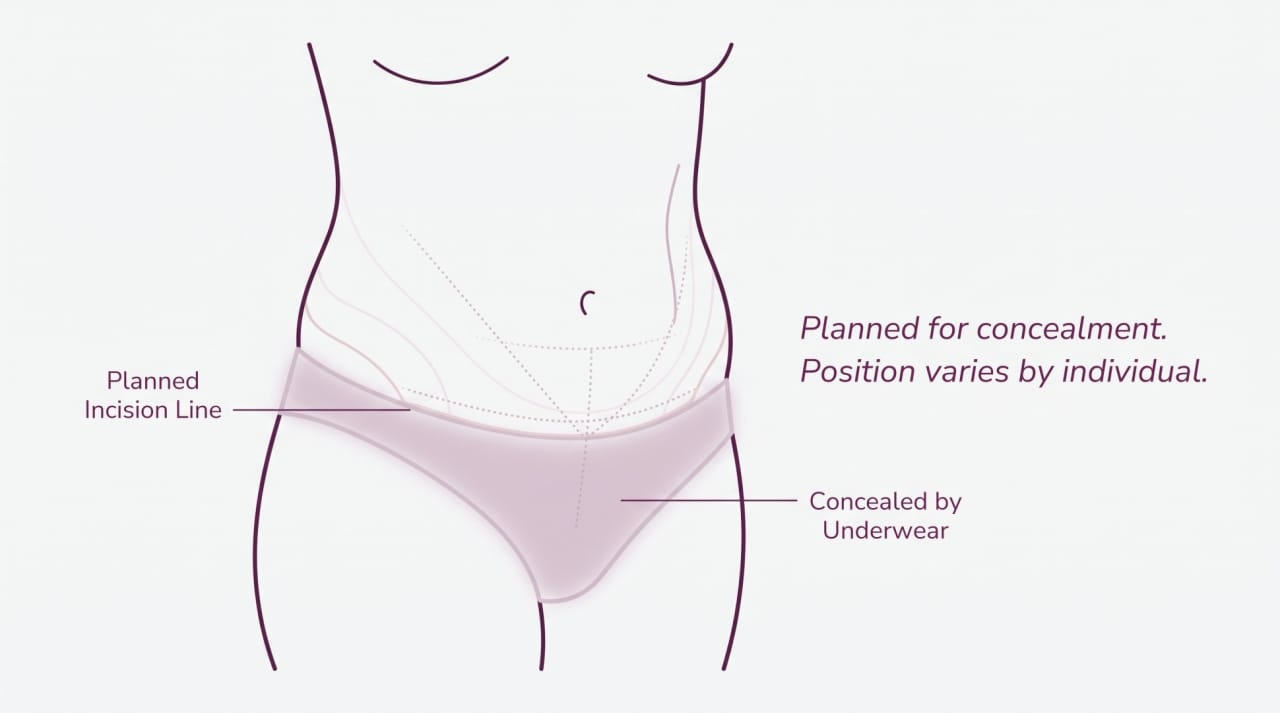
The incision runs low across the lower abdomen, hip to hip, and it is placed to sit below the line of underwear and most swimwear. It is permanent.
It fades over twelve to eighteen months and in most patients becomes pale and flat, but it does not disappear, and anyone who tells you otherwise is not preparing you properly. There is also a small scar around the repositioned navel.
This is the central trade of the operation, and it is a real one. What sits on the other side of it is a repaired abdominal wall, a flat lower abdomen, and in many patients a meaningful reduction in the lower back pain that comes with a core that has lost its midline.
Patients considering this almost always accept the scar readily, for the same reason women accept the scars of a breast reduction. The problem being corrected is functional as well as visual, and it has usually been present for years.
Recovery, Honestly
Surgery takes two to four hours under general anaesthesia. Most patients stay one night. Drains are usually placed and removed within the first week or so.
The first week is the most uncomfortable part, and the discomfort is specific. Because the abdominal wall has been tightened, you will stand and walk slightly bent forward for the first several days, and sitting up from lying down requires rolling onto your side first. This is expected and it resolves.
Desk work is realistic at around two to three weeks. No lifting anything heavier than a few kilograms for six weeks, which for mothers of small children is the genuine constraint and needs planning rather than optimism. Core exercise at eight to twelve weeks, reintroduced gradually and under guidance.
A compression garment is worn continuously for around six weeks. Swelling in the lower abdomen persists longer than patients expect and the final contour appears at six to twelve months.
On timing within the Delhi year, the determining factor is not the month but your environment. If you work and recover indoors in air conditioning, this can be scheduled at any point. If your days involve outdoor work, site visits, travel in the heat, or long periods in spaces without reliable cooling, continuous compression through April to June is genuinely difficult and either the cooler months or serious preparation is sensible.
When You Should Not Have This Operation Yet
There are three situations where I ask patients to wait, and I would rather say so publicly than have the conversation only after someone has made plans.
If you intend to have another pregnancy, wait. A subsequent pregnancy will stretch the repair and much of the benefit will be lost. This is not an absolute rule and some women proceed knowing they may need revision, but it should be a deliberate choice rather than an oversight.
If your weight is still moving significantly, wait until it has been stable for six to twelve months. The skin envelope is tailored to your body at the time of surgery, and substantial change afterwards in either direction will alter the result.
If you are less than a year postpartum, wait. The tissue is still remodelling, the separation may still narrow, and a measurement taken at six months is not a reliable basis for a permanent operation.
Waiting is not a refusal. It is the same principle that governs every other procedure I perform, which is that a permanent operation should be built on a stable foundation.
What This Operation Is Not
A tummy tuck is not a weight loss procedure and it is not primarily a fat procedure.
If your abdomen is firm and difficult to pinch, the volume is likely visceral fat sitting behind the muscle wall. No operation reaches it safely. It responds to diet and exercise, and in that specific case the advice you were given was correct.
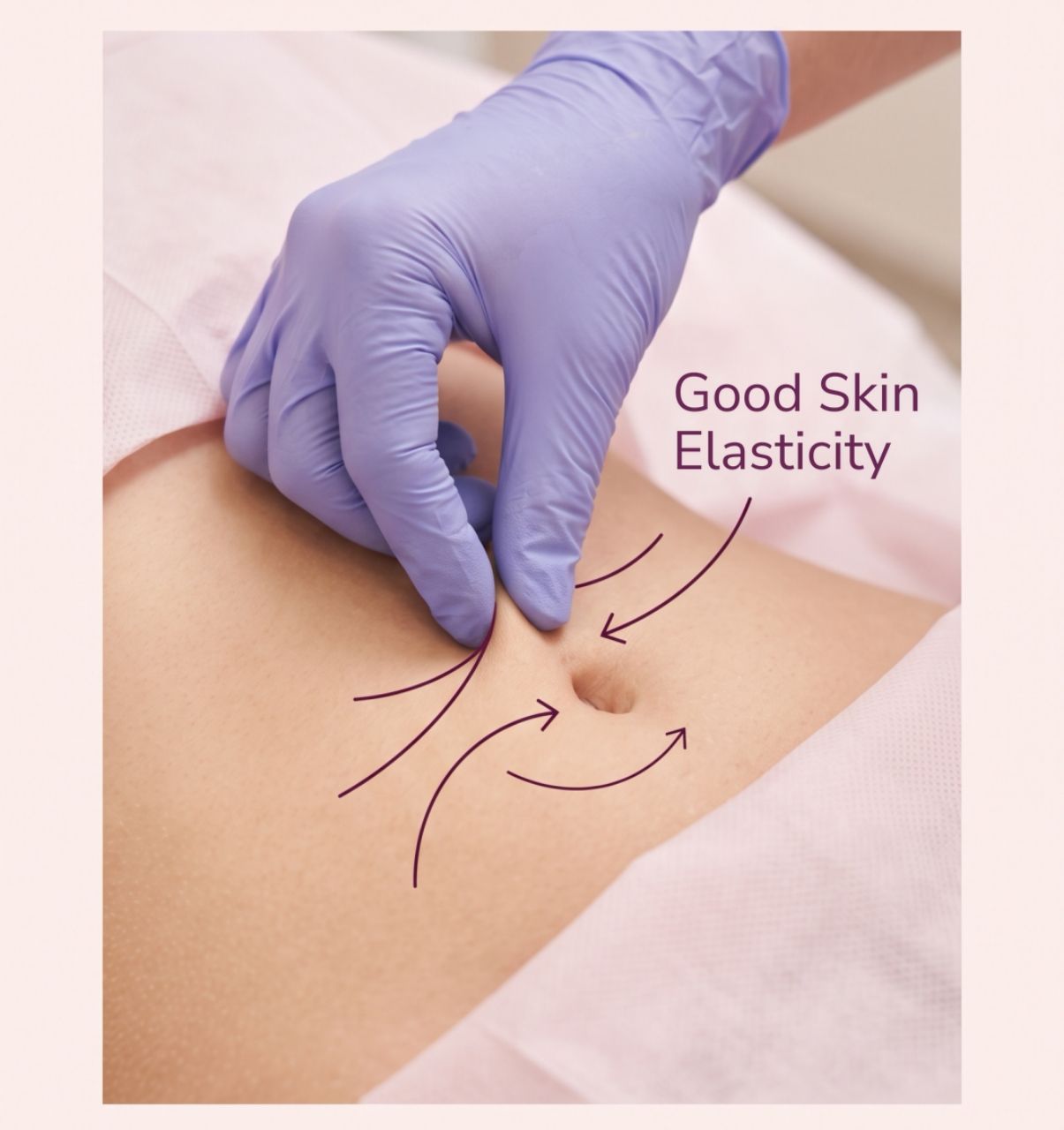
If your abdomen is soft, pinchable, with good skin elasticity and no separation, liposuction alone may be the right answer and an abdominoplasty would be a considerably larger operation than you need.
The patients for whom this operation is transformative are the ones with a structural abdominal-wall problem: muscle separation, stretched skin, or both. Identifying which of these you actually have is the entire purpose of the examination, and it is why a plan offered without one is not a plan.
Consultations in East of Kailash, South Delhi
We assess abdominal wall separation at our clinic in East of Kailash, a short distance from Kailash Colony metro on the Violet Line, and straightforward to reach from Greater Kailash I and II, Defence Colony, Lajpat Nagar, CR Park, Kalkaji, Jangpura, Nehru Place, and Sarita Vihar.
If you have been doing core work for a year without change, come and be measured. The examination takes two minutes and it will tell you whether you have been working on a problem that exercise was never going to solve.
Freyea Aesthetics
F-46, East of Kailash
New Delhi 110065, India
Dr. Ashutosh Misra, MCh (Plastic & Reconstructive Surgery), MS, MBBS
freyea.com