Rhinoplasty in Delhi: Why the Indian Nose Needs Its Own Surgical Plan
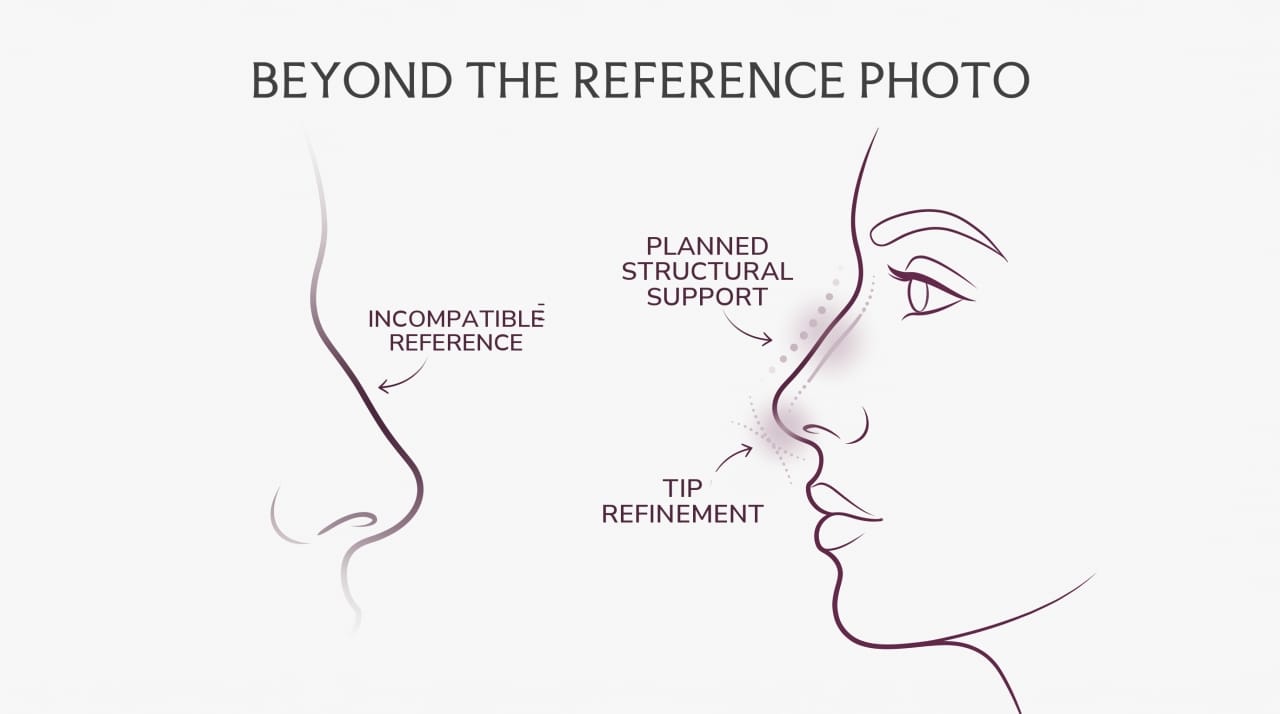
Almost every rhinoplasty consultation begins the same way. At some point in the first ten minutes, a phone comes out.
She turns the screen towards me. It is a photograph of an actress, or a model, or occasionally a stranger from an aesthetics account with several hundred thousand followers. The nose in the image is narrow, straight, with a defined tip and a supratip break that catches light cleanly. She says some version of the same sentence I have heard for twenty five years.
“Something like this.”
I always look at the photograph properly. It tells me a great deal about what she finds beautiful, which is genuinely useful information. But it also usually tells me that the nose she has chosen was built on an entirely different foundation from her own, and that reproducing it on her face would require me to remove structure she cannot afford to lose.
This is not a limitation of surgery. It is a fact about anatomy, and it is the single most important thing to understand before undergoing rhinoplasty in India.
What Is Actually Different
South Asian nasal anatomy differs from European nasal anatomy in several specific, measurable ways. These are not vague generalisations. They are structural characteristics that change the entire surgical approach.
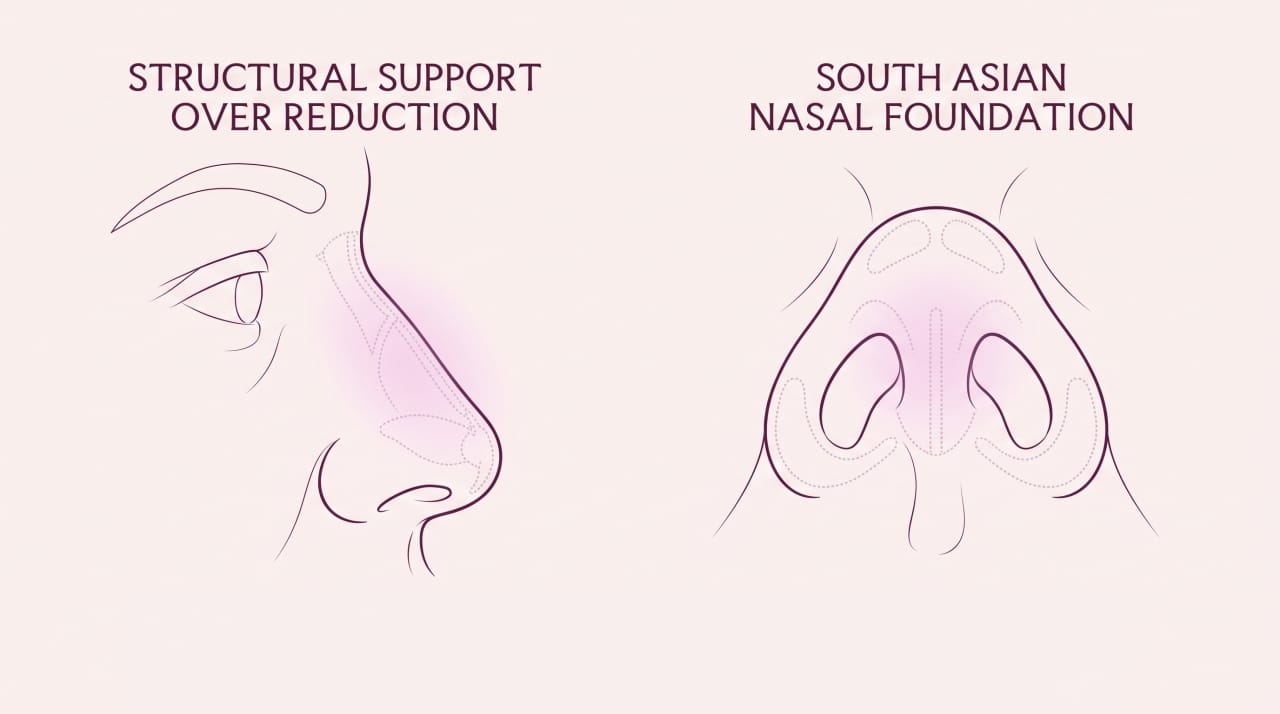
The first is the skin envelope. South Asian nasal skin is typically thicker, with a more sebaceous quality and a denser layer of subcutaneous fibrofatty tissue, particularly over the tip. This has two consequences. It resists showing definition, because fine cartilage contours underneath simply do not transmit through a thick covering. And it holds swelling far longer after surgery, which changes the entire recovery timeline.
The second is cartilage. The lower lateral cartilages, which form the framework of the tip, are frequently softer and less rigid than in European anatomy. They provide less intrinsic support. A technique that reduces these cartilages to create refinement removes support from a structure that did not have much to begin with.
The third is the radix, the root of the nose between the eyes. In South Asian anatomy it commonly sits lower and less projected. A dorsum that appears to have a hump often does not have an excessive hump at all. It has a low starting point, which creates the visual impression of a bump further down. Reducing the dorsum in this situation lowers a bridge that was never high to begin with.
The fourth is the alar base. It is often wider, with more flared nostrils and a shorter, less projected columella. This is a proportional characteristic of the face as a whole, not a deformity, and it responds to careful base modification rather than aggressive narrowing.
Taken together, these features describe a nose that needs support added, not structure taken away.
Why Reduction Alone Produces the Operated Look
For much of the twentieth century, rhinoplasty was fundamentally a reduction operation. Take down the hump, narrow the bones, trim the tip cartilages, close. It was developed on and for a particular anatomy: thin skin over strong cartilage, where removing structure reveals definition because the skin drapes tightly over what remains.
Apply that same operation to thick skin over soft cartilage and several things go wrong, predictably and in sequence.
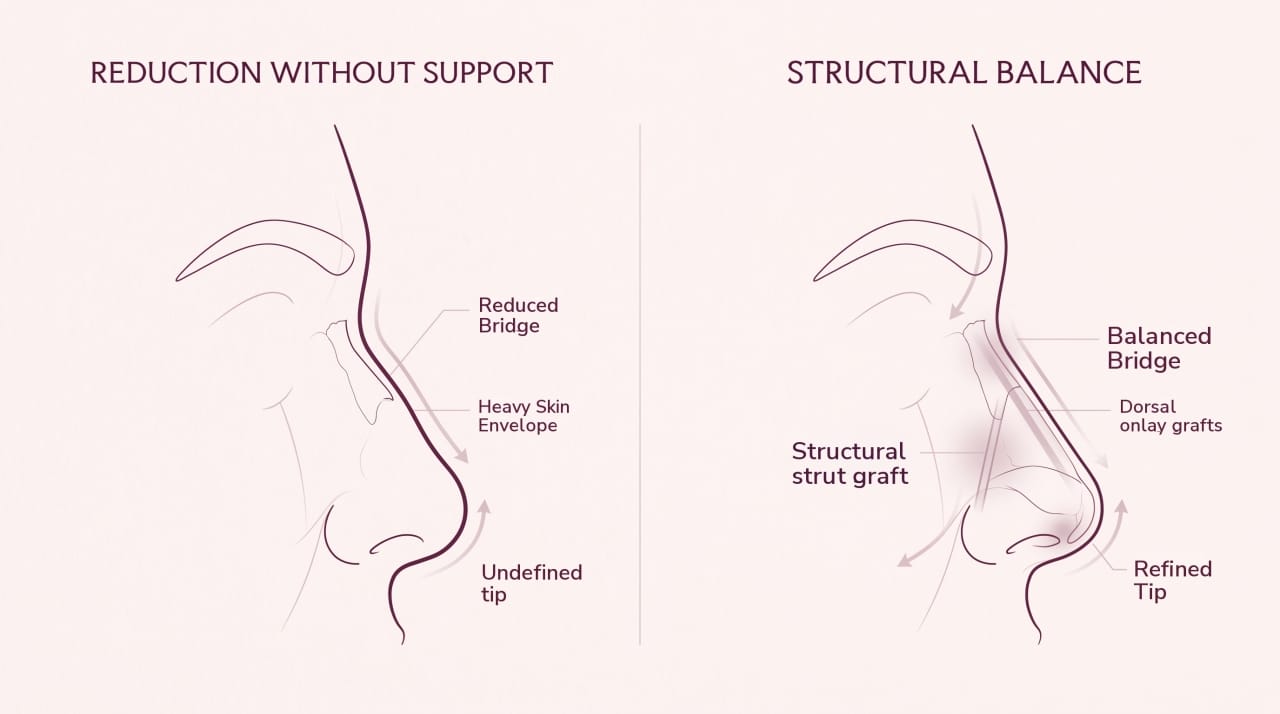
The tip loses support and rotates downward over the following years, because the cartilage that was holding it up was trimmed. The middle vault collapses inward after the bones are narrowed, creating both a visible inverted V deformity and, frequently, a breathing obstruction that was not present before surgery. The thick skin over the supratip does not redrape onto the reduced framework beneath it and instead fills in with scar tissue, producing the rounded fullness above the tip known as a polly beak.
And the nostrils, narrowed aggressively at the base, pinch inward in a way that reads instantly as surgical.
This is the collapsed, over-narrowed, unmistakably operated result that you can see walking around Delhi in reasonable numbers. It is not usually the result of poor technique in a mechanical sense. The incisions were clean and the sutures were fine. It is the result of applying the correct operation to the wrong anatomy.
Structure Rather Than Subtraction
Modern rhinoplasty for South Asian anatomy is largely a structural operation. The governing principle is that support is added, and reduction is performed sparingly and only where the anatomy can tolerate it.
In practice this means using cartilage grafts, most often harvested from the nasal septum, occasionally from the ear or rib in revision cases where septal cartilage has already been used. A columellar strut or septal extension graft provides the tip with support it does not naturally possess, allowing projection and rotation to be set deliberately and held over time. Spreader grafts placed along the middle vault preserve both the aesthetic lines of the dorsum and the internal nasal valve, which is where most post-rhinoplasty breathing problems originate. Tip grafts, used judiciously, create definition that thick skin will actually transmit.
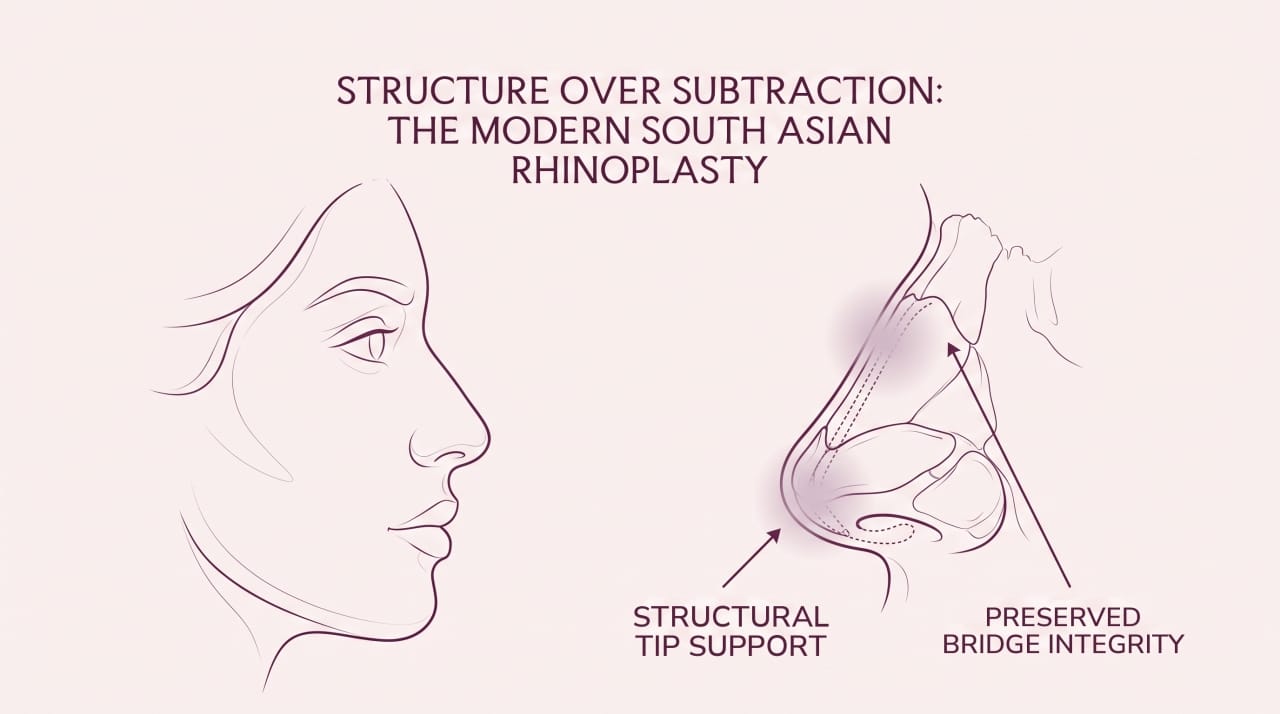
Where the dorsum is low, augmentation rather than reduction may be the correct answer. Where the alar base is wide, a carefully measured base reduction preserves the natural curve of the nostril rim rather than straightening it.
The result of a structural approach is a nose that holds its shape at ten years rather than one that looked its best at six months and has been settling ever since.
It is also, and this matters, a nose that breathes. Function and appearance are not separate projects in rhinoplasty. The structures that create an attractive dorsal line are the same structures that keep the airway open. A rhinoplasty that improves appearance while compromising breathing has not succeeded. It has traded.
The Timeline Nobody Warns You About
This is where thick skin exacts its price, and where I spend a considerable part of every rhinoplasty consultation setting expectations that patients find surprising.
After a rhinoplasty on thin skin, most of the swelling resolves within three to six months and the final result is substantially visible within a year.
Thick skin does not behave this way. The subcutaneous tissue over the tip holds oedema for far longer, and the definition you were promised emerges gradually rather than appearing. Meaningful refinement continues for twelve to eighteen months, and in some patients the tip is still settling at two years.
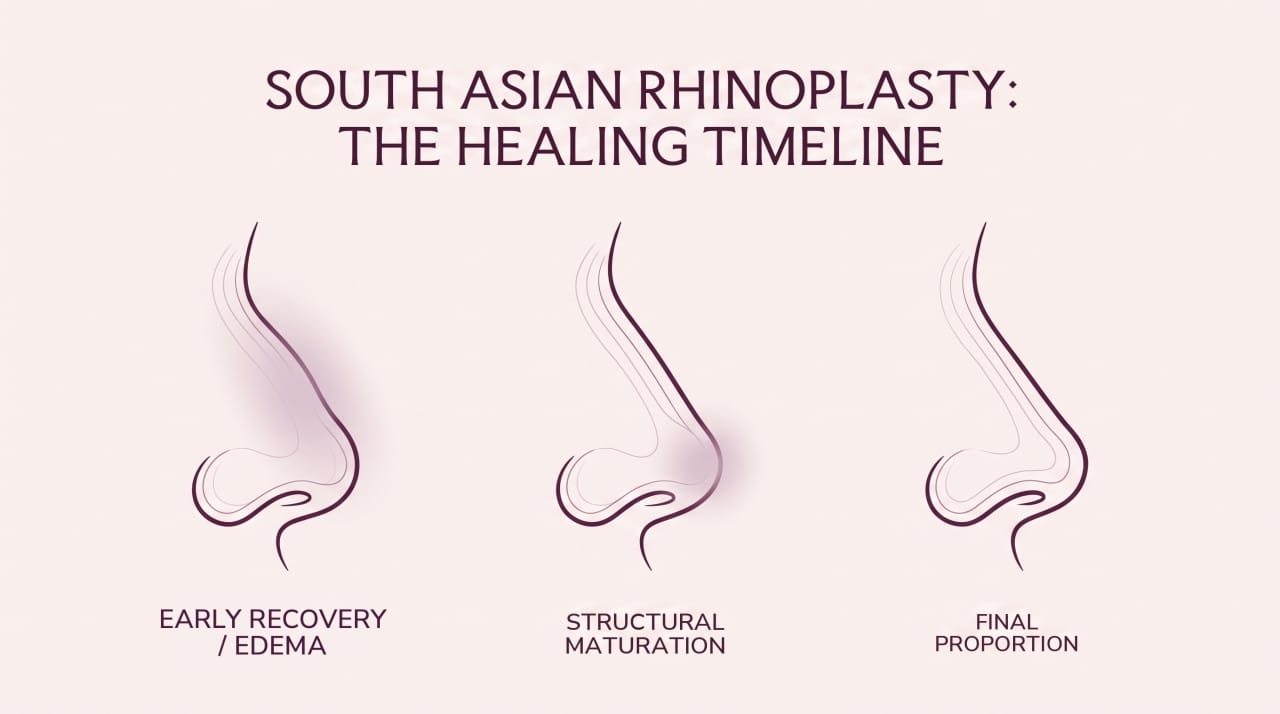
This is not a complication. It is the normal healing behaviour of your specific tissue. But if nobody tells you, month five is distressing. The nose looks fuller than you expected, the tip looks less defined than the plan suggested, and the natural conclusion is that something has gone wrong.
I tell patients this before surgery, repeatedly, and I photograph at intervals so that we are comparing against evidence rather than memory. Memory is unreliable in rhinoplasty. Patients forget what their nose looked like with remarkable speed, which is a strange and consistent feature of this operation.
If you are planning a rhinoplasty around a wedding, and in Delhi a substantial number of them are, work backwards honestly. You will look presentable within a few weeks. You will not be seeing your final result. Build the timeline around the tissue, not the calendar.
The Photograph, Revisited
I want to return to the phone, because I do not want the point to be mistaken for a refusal.
When a patient shows me a reference image, I am not going to tell her that her aesthetic preferences are wrong. They are not. What I am going to do is separate what she actually wants from the particular nose she has used to express it.
Usually, when we talk it through, the underlying request is not that specific nose at all. It is more definition at the tip. A straighter line in profile. Less width across the base. Better balance with the rest of her face. These are achievable requests, and they are achievable on her anatomy, using her cartilage, within the structural limits of what she has.
What is not achievable is transplanting the geometry of one face onto another. A nose is not an accessory that can be selected independently of the face it sits on. It has relationships with the brow, the cheekbones, the chin, the lips, and the overall proportions of the midface. Change it in isolation and it stops belonging.
The most common cause of an unhappy rhinoplasty result is not surgical error. It is a nose that was technically well executed and belongs to somebody else.
What Belonging Looks Like
The rhinoplasty results I am most satisfied with are the ones nobody notices.
Not because the change was small, but because the new nose reads as though it was always there. Friends say the patient looks well, or rested, or ask whether she has changed her hair. Nobody says she has had her nose done, because there is no visual signature of surgery to detect. The proportions simply resolved.
That is the standard. Not a dramatic before and after, but a face that has become more coherently itself.
It requires planning that begins with your anatomy rather than with a reference image, technique that adds support rather than removing it, and a surgeon willing to tell you which parts of what you are asking for are achievable and which are not.
Your nose has its own architecture. The work is to make it the best possible version of that architecture, not to replace it with someone else's.
If you are considering rhinoplasty and want an assessment that begins with your anatomy rather than a reference photograph, you are welcome at Freyea Aesthetics, East of Kailash, South Delhi. We see patients from across Greater Kailash, Defence Colony, Lajpat Nagar, CR Park, and Nehru Place, and are a short distance from Kailash Colony metro.
Dr. Ashutosh Misra
Founder, Freyea Aesthetics | East of Kailash, South Delhi
MCh (Plastic & Reconstructive Surgery), MS (General Surgery), MBBS
25+ years of surgical experience
freyea.com