Mommy Makeover in South Delhi: What It Includes, and When You Are Actually Ready
I dislike the name, and I want to start there, because the name is responsible for most of the confusion around this operation.
Mommy makeover suggests a single restorative procedure. Something applied to a woman that returns her to a previous state. It implies one problem with one solution, and it implies that the problem is appearance.
What it actually describes is two or three separate operations, addressing two or three distinct structural changes, performed together under one anaesthetic because combining them is more efficient than staging them. The changes are not cosmetic in origin. They are mechanical, and they are the consequence of a body having done something physically demanding.
Understanding it as a combination rather than a treatment changes how you evaluate it, because each component has to be justified separately and each carries its own trade-offs.
The Three Things Pregnancy Actually Changes
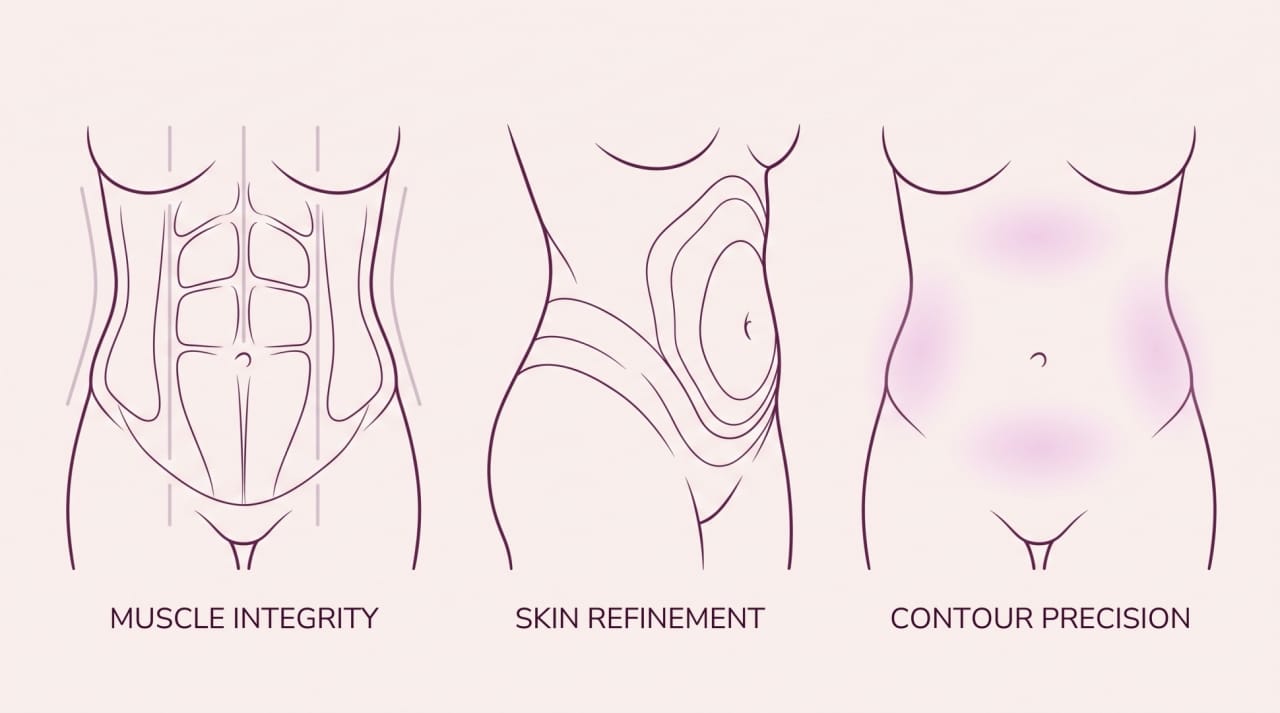
When a woman tells me she wants her body back, she is usually describing some mixture of three distinct problems. They have different causes and they need different operations, and a great deal of disappointment in this field comes from treating one while leaving another untouched.
The abdominal wall
The two vertical columns of abdominal muscle separate at the midline during pregnancy, a condition called diastasis recti. For many women it narrows in the months after delivery. For a substantial number it does not, and once a year has passed without closure it is generally structural.
The result is a lower abdominal bulge that persists regardless of fitness, because the abdominal wall has lost its central anchor and the contents behind it push forward into the gap. It is not fat. Once structural, core work cannot close it, and traditional crunches can widen it. I have written about this separately because it deserves its own explanation.
The skin envelope
Skin stretched over months at a time does not always retract. Where the dermis has been damaged, which is what striae represent, the elastic recoil is permanently reduced. A woman can return to her pre-pregnancy weight and still carry a loose, crepey lower abdomen, because the skin has more surface area than the body underneath now requires.
No exercise, cream, or non-surgical device meaningfully corrects dermal damage of this kind. Skin excess is addressed by removing skin.
The breast
During pregnancy and lactation the breast enlarges substantially. After breastfeeding ends, the glandular tissue involutes, and the breast frequently returns to a smaller volume than before, inside a skin envelope that was stretched to accommodate the larger one.
The result is a breast that has lost volume in the upper pole, sits lower on the chest wall, and in many cases has a nipple position that has descended relative to the fold beneath. Which of those predominates determines whether the right operation is a lift, an implant, both, or in some cases a reduction. This is a decision women frequently get wrong, and I have written about it separately as well.
Why the Distinction Matters So Much
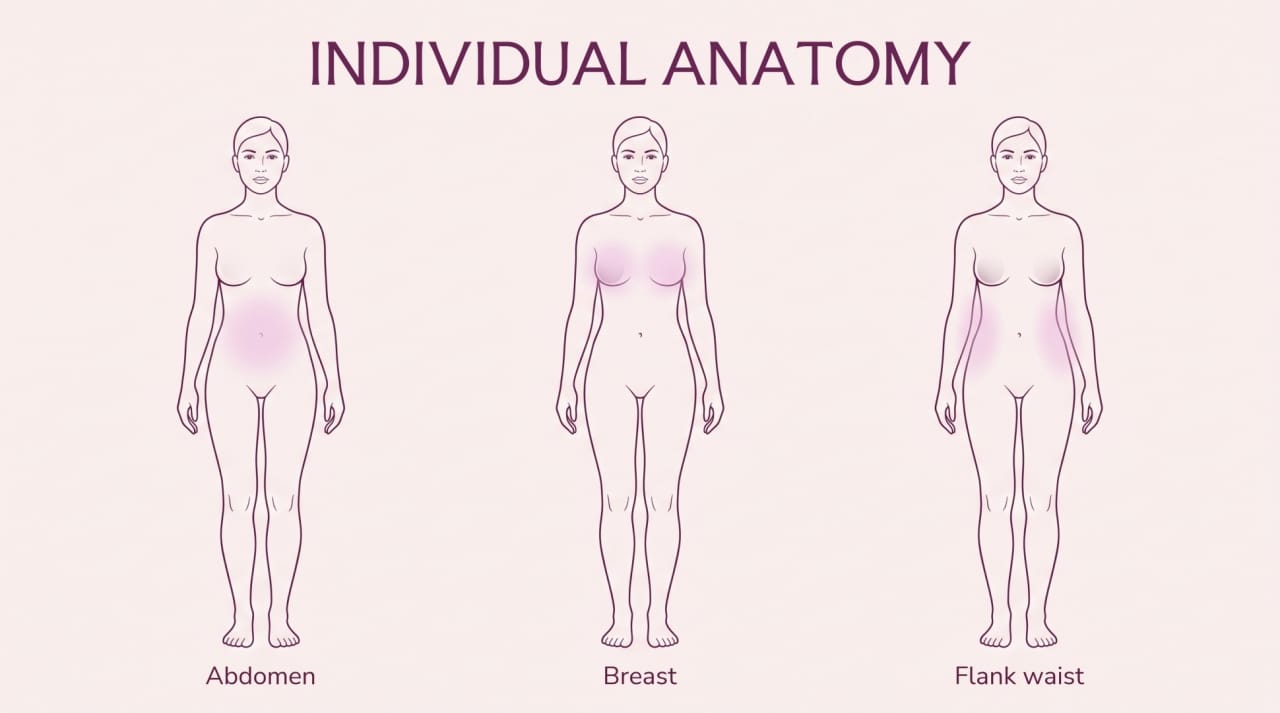
Because the wrong combination produces an expensive disappointment.
A woman with significant muscle separation who is given liposuction alone will have a thinner abdomen with the same bulge. A woman with stretched skin who is given muscle repair without skin excision will have a flat wall under loose skin. A woman whose breasts have deflated and descended who is given implants alone will have larger breasts that still sit low, because an implant adds volume and does not lift.
Each of those is a technically competent operation producing an unsatisfactory result, because the operation did not match the problem.
So the consultation for this is longer than most. I examine the abdominal wall for separation and measure it. I assess skin quality, elasticity, and striae distribution. I examine the breast and measure nipple position relative to the inframammary fold, which is the measurement that decides the breast component. Only then can we talk about what the combination should be.
What Gets Combined, and What Should Not
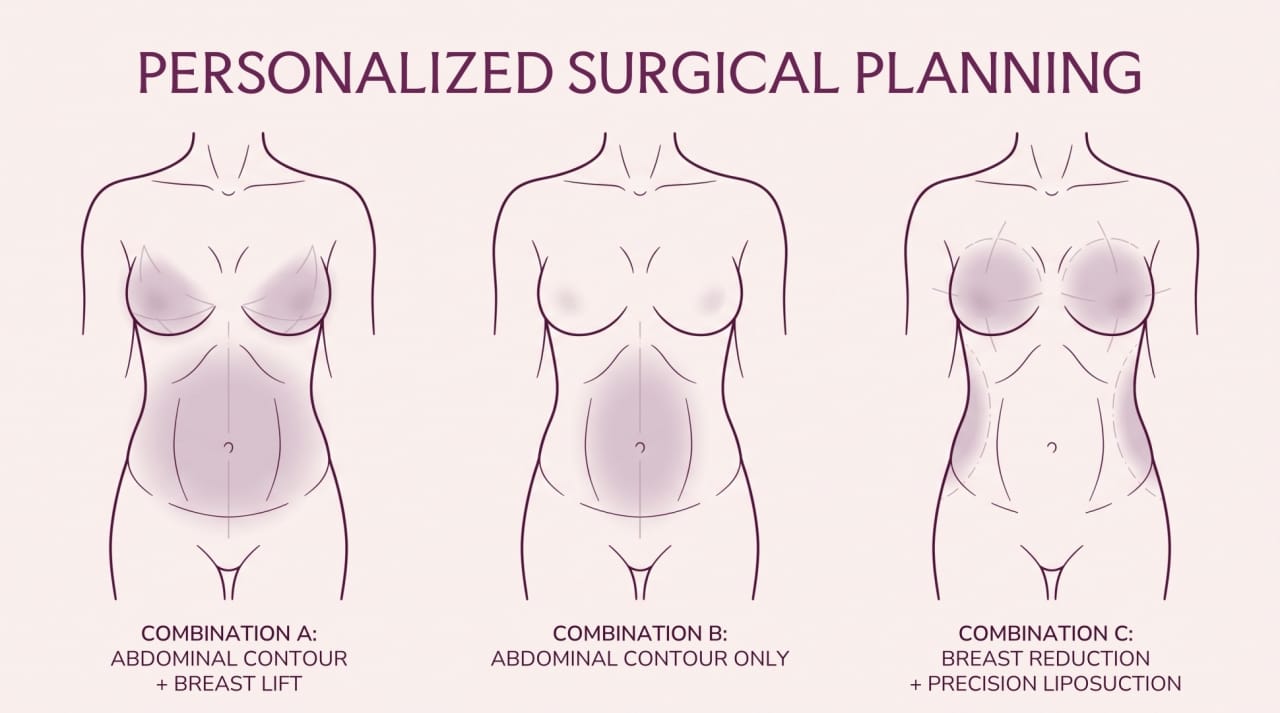
A typical combination is an abdominoplasty with rectus plication, liposuction of the flanks and upper abdomen to refine the contour, and a breast procedure appropriate to what the breast actually needs.
Combining them in one anaesthetic has real advantages. One recovery instead of two or three. One period away from work. One set of anaesthetic risks rather than repeated exposure. For most women this is both safer in aggregate and considerably more practical.
But there is a limit, and it is a safety limit rather than a preference.
Total operating time matters. Longer procedures carry higher risk of venous thromboembolism, greater fluid shifts, more blood loss, and longer anaesthetic exposure. Where the combination would push the operation beyond a reasonable duration, the correct answer is to stage it across two sessions rather than to compress everything into one long day.
I would be cautious of any practice that agrees to an unusually extensive combination without raising this. A willingness to do everything at once is not always a sign of capability.
When You Are Actually Ready
This is the part of the conversation I spend most time on, because readiness for this operation is more specific than for almost anything else I do.
Your family is complete
A subsequent pregnancy will stretch a repaired abdominal wall and much of the muscle repair will be undone. It will also change the breast again. This does not make surgery before a further pregnancy impossible, and some women proceed knowing they may want revision later, but it should be a deliberate decision rather than something nobody mentioned.
Your weight has been stable
Six to twelve months of stability, ideally at or near the weight you expect to maintain. The skin envelope is tailored to your body on the day of surgery. Significant change afterwards, in either direction, alters the result, and substantial weight loss after an abdominoplasty can produce new laxity in skin that has already been tightened once.
You have finished breastfeeding
Breast volume continues to change for several months after lactation stops. Operating before it has settled means planning around a breast that is still changing. I generally ask for at least three to six months after breastfeeding has fully ended before assessing the breast component.
You are at least a year postpartum
The abdominal tissue is still remodelling in the first year and the separation may still be narrowing. A measurement taken at six months is not a reliable basis for a permanent operation.
The Constraint Nobody Plans For
There is a practical reality about this operation that matters more than almost anything clinical, and it gets discussed far too late.
After an abdominoplasty you cannot lift anything heavy for six weeks. In practice that means you cannot pick up a small child.
This is the defining feature of recovery from a mommy makeover, and the irony is not lost on anyone. The women having this operation are, by definition, the women most likely to have a two year old who wants to be carried.
It cannot be worked around. Lifting a toddler in the first six weeks risks disrupting the muscle repair, which is the central component of the whole operation. So it has to be planned for rather than hoped through.
What that means in practice: real help arranged for at least the first three weeks, and partial help for three more. A partner taking leave, family staying, or paid help engaged in advance. A conversation with older children beforehand about why you cannot pick them up, which parents consistently report goes better than they expected. A sleeping arrangement that does not require you to lift a child into a cot.
Women who arrange this properly recover well. Women who assume they will manage tend to lift when they should not, and I would rather have this conversation in a consultation room than at a two week review.
Recovery, in Sequence
Surgery takes three to five hours depending on the combination, under general anaesthesia, usually with one or two nights in hospital. Drains are typically placed in the abdomen and removed within the first week or so.
The first week is the most demanding. Because the abdominal wall has been tightened you will stand and walk slightly bent forward for several days, and getting up from lying down means rolling onto your side first.
Desk work is realistic at two to three weeks. Driving at around three weeks. No lifting beyond a few kilograms until six weeks. Light cardio at six weeks, core work at eight to twelve, reintroduced gradually.
Compression garments are worn continuously for around six weeks, and for the breast component a supportive surgical bra for the same period.
Swelling resolves slowly and the final contour appears at six to twelve months. Scars mature over twelve to eighteen.
On timing within the year, the determining factor is your environment rather than the calendar. If you work and recover indoors in air conditioning, this can be scheduled whenever suits your life. If your days involve outdoor work, travel in the heat, or long periods in spaces without reliable cooling, wearing continuous compression through April to June is genuinely difficult, and either the cooler months or careful preparation makes sense.
On Cost
I will not quote a range here, because this is the one procedure where a published figure would mislead more than it helps.
A mommy makeover is not a single operation with a single price. It is a combination, and the cost depends entirely on which components are included, how extensive each is, total theatre time, length of stay, and whether the breast element is a lift, an implant, both, or a reduction. Two women using the same phrase can need operations that differ substantially in scope.
What you should expect is an itemised quote that separates the components, rather than one number for a package. Ask what each element costs, what the theatre and anaesthesia charges are, how many nights are included, what happens if you need an additional night, and what the written revision policy is. A combination quoted as a single undifferentiated figure is difficult to evaluate and difficult to compare.
Consultations in East of Kailash, South Delhi
We assess and plan combination post-pregnancy surgery at our clinic in East of Kailash, a short distance from Kailash Colony metro on the Violet Line, and easily reached from Greater Kailash I and II, Defence Colony, Lajpat Nagar, CR Park, Kalkaji, Jangpura, Nehru Place, and Sarita Vihar.
Consultations for this are long, because there are three separate assessments inside one appointment. Bring your actual timeline, including whether you are considering another pregnancy and what help you could realistically arrange for a six week recovery. Those two answers shape the plan more than anything I find on examination.
Freyea Aesthetics
F-46, East of Kailash
New Delhi 110065, India
Dr. Ashutosh Misra, MCh (Plastic & Reconstructive Surgery), MS, MBBS
freyea.com