Liposuction Is Not Weight Loss. It Never Was.

She tells me she wants to lose ten kilograms. She points to her abdomen, her hips, her thighs. She has read about liposuction. She has seen the before-and-after photographs. She has a wedding in four months and she would like to be “a different size” by then.
I listen. And then I tell her something that will save her a great deal of money and a greater deal of disappointment: liposuction cannot do what she is asking it to do.
Not because the technology is limited. Not because her body isn’t suitable. But because liposuction was never designed to be a weight loss procedure. It does not reduce your size in a meaningful, global sense. It does not replace the metabolic work of caloric deficit, movement, and time. It does something else entirely. Something more specific, more targeted, and more modest than the word “lipo” tends to suggest.
And the distance between what liposuction actually does and what many patients believe it does is the most common source of disappointment in aesthetic surgery. Not just in my practice. Everywhere.
Two Kinds of Fat, and Only One That Listens to You
Fat in the human body is not one uniform substance doing one uniform thing. It exists in different compartments, with different metabolic behaviours, different hormonal sensitivities, and different genetic mandates.
Some fat is metabolically obedient. It responds to diet. It responds to exercise. When you create a sustained caloric deficit, this fat is mobilised, broken down, and used for energy. It sits viscerally around your organs and subcutaneously across large surface areas of your body. It is the fat that dieting was designed to address, and it does its job.
And then there is the other kind.
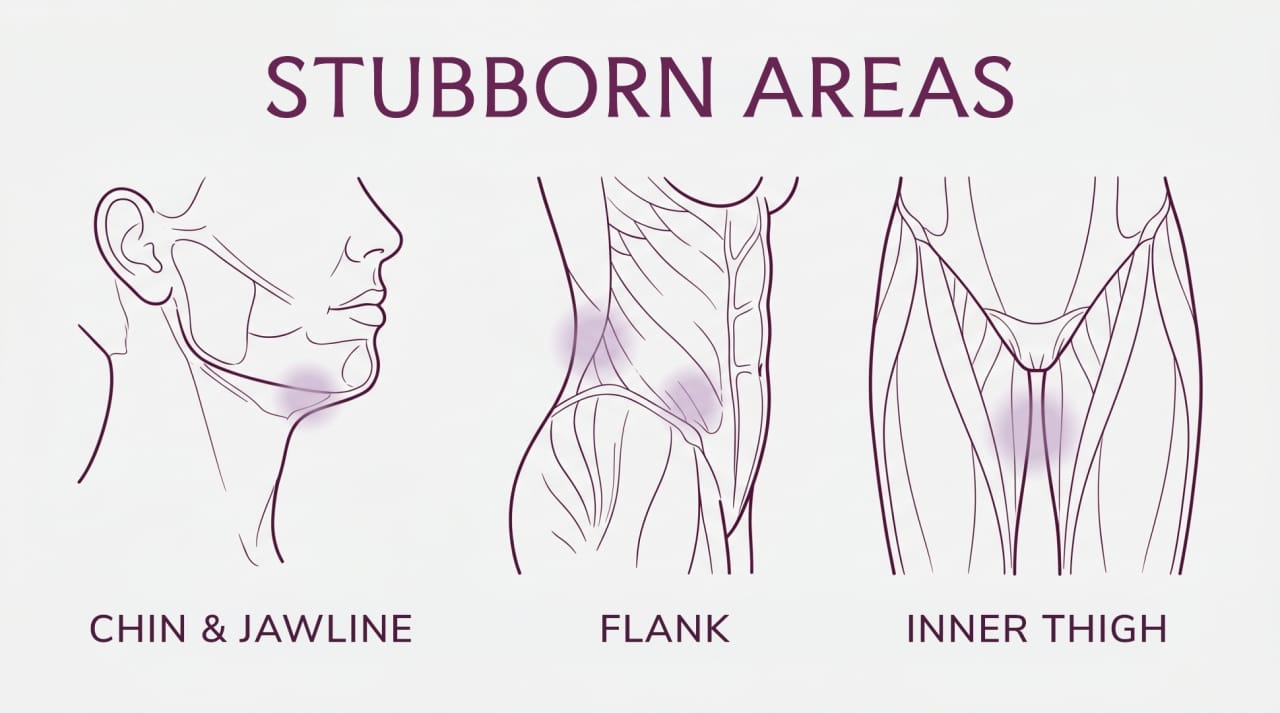
Localised, genetically determined fat deposits that your body has decided to keep. The pocket on your flanks that remains after every diet you have ever completed. The inner thigh fullness that has been unchanged at every weight you have ever been. The layer beneath your chin that you can trace through three generations of family photographs. The lower abdominal pouch that sits, immovable, below a flat upper abdomen, as though the two regions received entirely different instructions.
They did receive different instructions. That is exactly the point.
These deposits are not an excess problem. They are a distribution problem. Your body has placed fat in locations where it has no metabolic intention of removing it, regardless of your discipline. They are programmed compartments, not overflow.
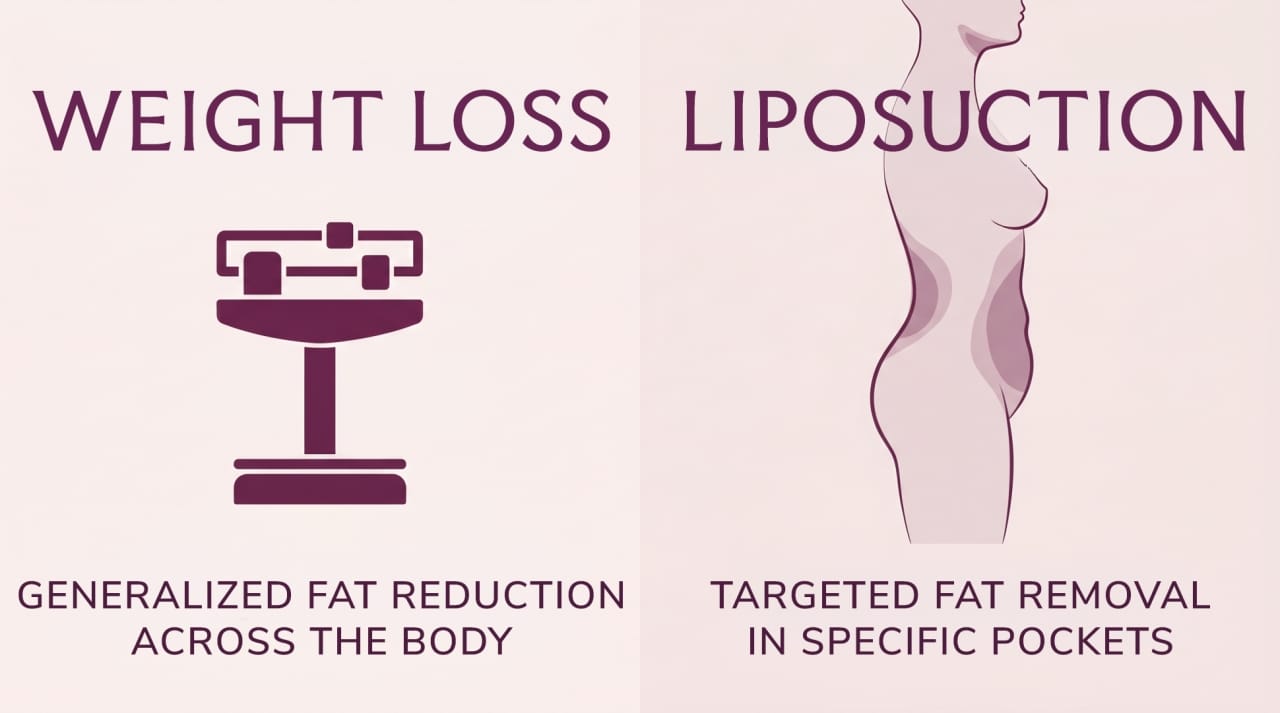
Liposuction addresses this second category. It removes fat from specific, targeted zones where diet and exercise have no meaningful reach. It contours. It sculpts. It refines a silhouette that is already close to where you want it but has stubborn architectural features that willpower simply cannot renegotiate.
That is its job. That is the full extent of its job.
What a Litre of Fat Actually Looks Like
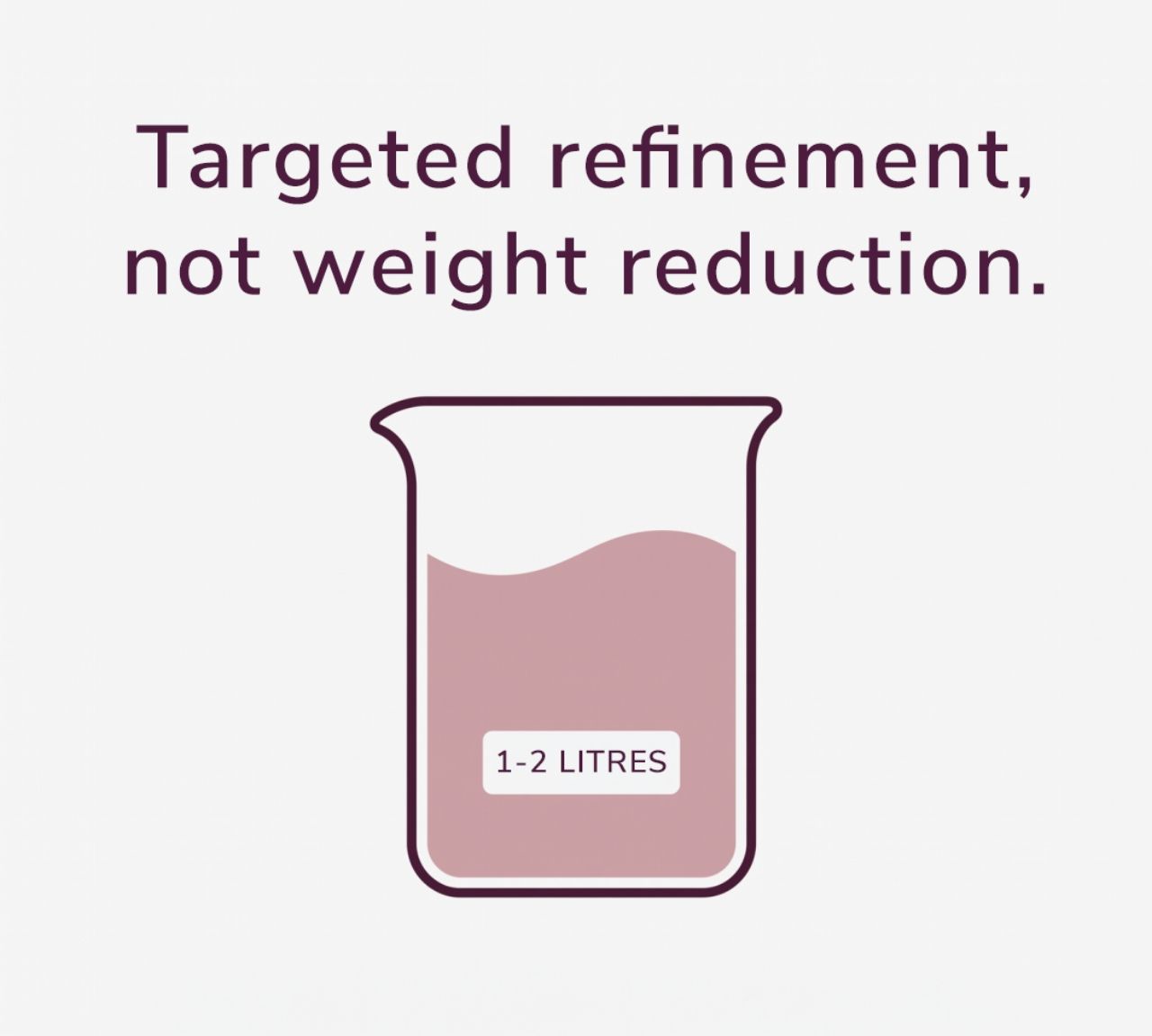
When I perform liposuction on an appropriate candidate, I am typically removing between one and three litres of fat from a targeted area. Sometimes less. In larger-volume cases, somewhat more. But let me put those numbers in perspective.
A litre of fat weighs approximately 0.9 kilograms. If I remove two litres from your flanks, you have lost roughly 1.8 kilograms on a scale. That is the weight of a small bag of rice. Barely perceptible as a number.
On your body, in the mirror, the change can be transformative. Because the change is not about weight. It is about shape.
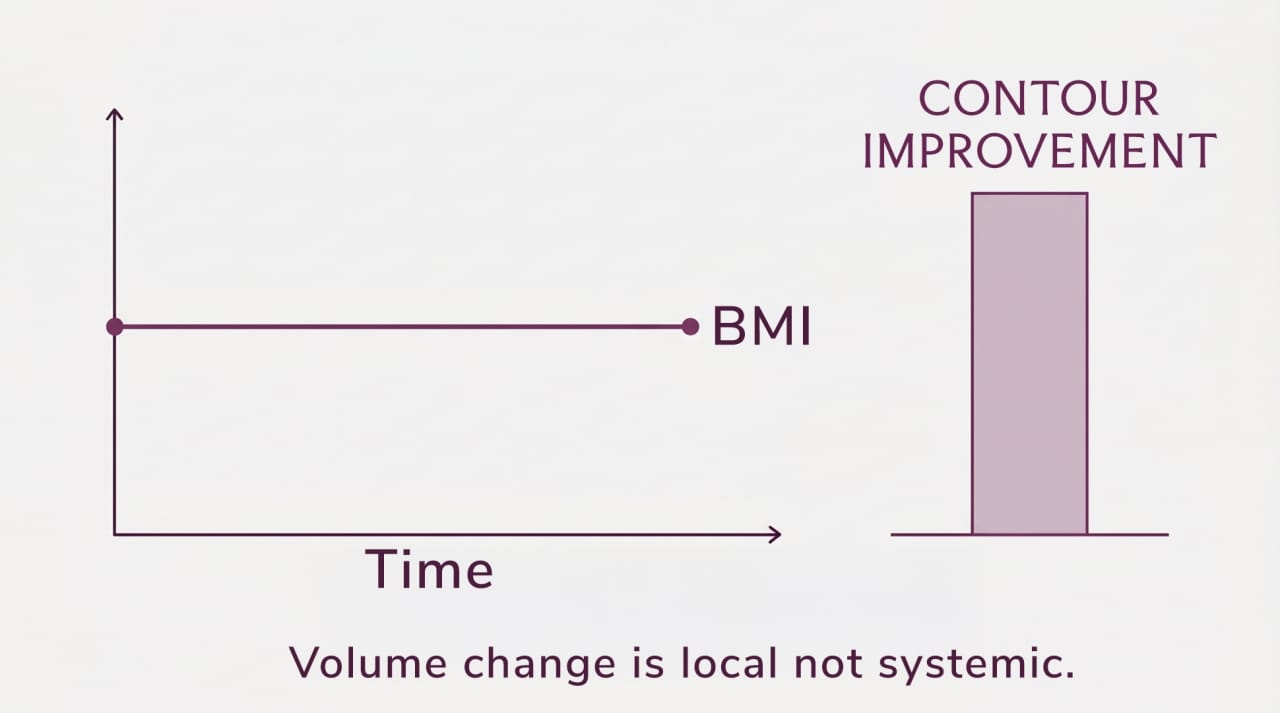
This is the distinction that gets lost in marketing, and it is the one that matters most. The before-and-after photographs you see online are real. The contour change is genuine. The patient looks meaningfully different. But if you put that patient on a scale before and after surgery, the number has barely moved. What changed is not mass. What changed is geometry.
If you are hoping to go from 85 kilograms to 70 through liposuction, the procedure will disappoint you. Not because it failed, but because it was never built to operate at that scale. That fifteen-kilogram deficit is a metabolic project. It involves nutrition, activity, time, and sometimes medical or bariatric intervention. Liposuction does not belong in that conversation.
The Person Liposuction Was Designed For
The ideal liposuction candidate is, in my experience, someone who frustrates their personal trainer.
They are at or near their healthy weight. Their fitness is consistent. Their diet is reasonable. And yet there are specific zones on their body where fat sits in a way that feels disproportionate, resistant, and genetically imposed. They have done the work. The work has not reached these areas. That is not a failure of discipline. That is the biological reality of compartmentalised fat distribution.
This patient is not looking to become smaller. They are looking to become more proportional. They want the silhouette to match the effort they have already invested. And for this specific, precisely defined problem, liposuction is effective, predictable, and deeply satisfying.
The patient who is 20 or 30 kilograms above their healthy weight is a different conversation entirely. Liposuction will not address the volume they need to lose. It will refine a small zone while the larger picture remains unchanged, and the result will feel underwhelming compared to the expectation, even when the surgical work was technically excellent.
I do not say this to exclude anyone. I say it to protect the experience. A procedure that meets accurate expectations feels like a revelation. The same procedure measured against inaccurate expectations feels like a failure. The surgery is identical. The difference is the conversation that preceded it.
Perfect Surgery, Wrong Expectation
This is the outcome I work hardest to prevent, because it is the most disheartening for everyone involved.
The surgery goes well. The fat is removed cleanly. The contour improvement is visible, natural, proportionate. The recovery proceeds as expected. And the patient is disappointed.
Not because anything went wrong. But because they expected a different category of result. They expected weight loss. They received reshaping. They expected their clothes to fit several sizes smaller. Their clothes fit the same size, but the body inside them has changed. They expected the scale to move. The scale registered a kilogram.
The procedure did exactly what it was designed to do. But the patient was never prepared for what “exactly what it was designed to do” actually looks and feels like.
This is why the conversation before surgery matters more than the surgery itself. If I can establish, clearly and without ambiguity, that liposuction is a contouring instrument and not a reduction instrument, the patient who proceeds does so with eyes calibrated to the right scale. And in aesthetic medicine, calibrated expectations are the single greatest predictor of satisfaction. Not technique. Not technology. Expectations.
Reshape, Not Reduce
If there is one sentence I want anyone considering liposuction to carry into their consultation, it is this: liposuction reshapes. It does not reduce.
It is extraordinarily good at what it does. In the right hands, on the right candidate, it can refine a contour with a precision that no amount of exercise will replicate. It can address the specific, inherited, resistant deposits that make a body feel incongruent with the effort being invested in it. It is one of the most predictable and satisfying procedures in aesthetic surgery when it is understood correctly.
But it is not weight loss. It was never weight loss. And the clinic that frames it as weight loss, that implies you will emerge globally smaller, is selling a misunderstanding.
Understanding this before you walk into a consultation is not discouraging. It is clarifying. It means that if you do proceed, you proceed knowing exactly what the mirror will show you and exactly what the scale will not. And the result, measured against the right expectation, will feel exactly as good as it should.
If you are considering liposuction and want a consultation that begins with this distinction, you are welcome at Freyea Aesthetics, South Delhi. We would rather have an honest conversation now than manage a disappointment later.
Dr. Ashutosh Misra
Founder, Freyea Aesthetics | South Delhi
MCh (Plastic & Reconstructive Surgery), MS (General Surgery), MBBS
25+ years of surgical experience
freyea.com