Hair Transplant in South Delhi: How to Read a Quote Before You Sign One
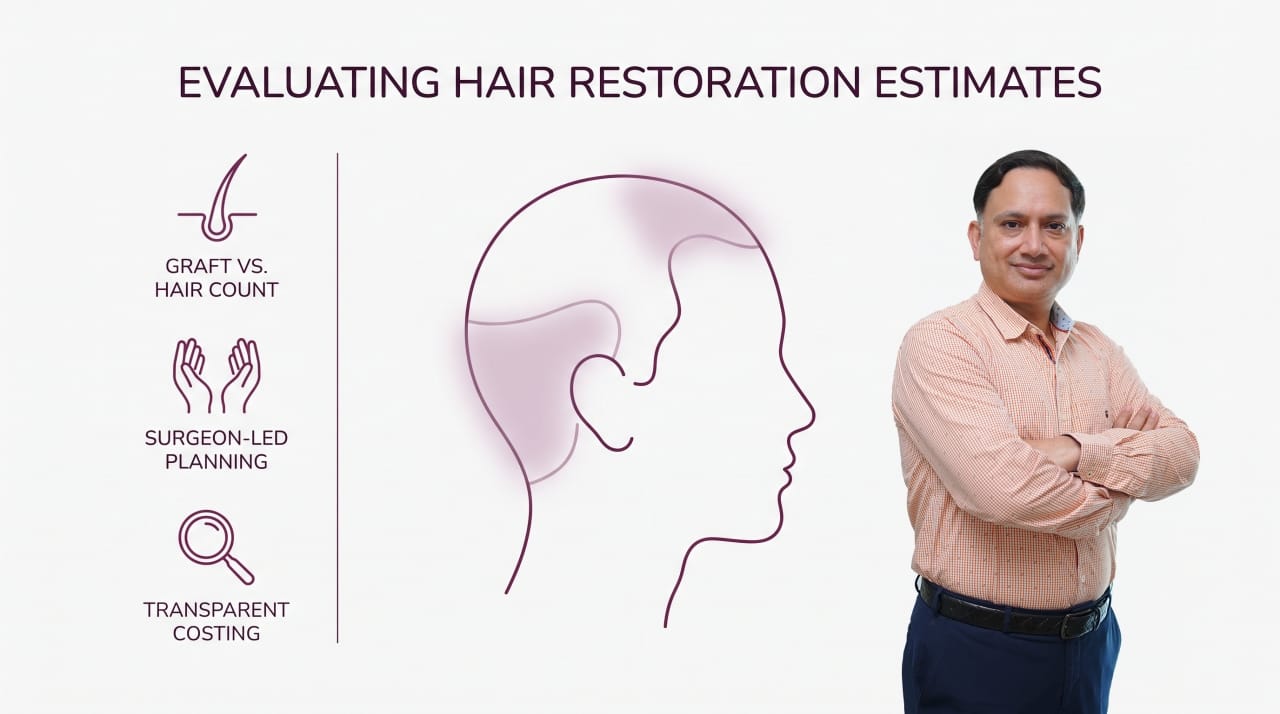
He brought three quotes with him. Printed, folded, carried in a laptop bag from an office in Nehru Place to my consultation room in East of Kailash, a distance of about fifteen minutes and, in terms of what those three documents claimed, an enormous distance in every other sense.
Three clinics. The same city. The same man, the same scalp, the same pattern of loss. The cheapest quote was less than a third of the most expensive. All three used the word FUE. All three promised a natural hairline. And he had no framework whatsoever for understanding why the numbers diverged so wildly, because nobody had given him one.
So we spent the consultation doing something unusual. Instead of producing a fourth quote, we read the three he already had.
What follows is that reading, generalised. If you are considering a hair transplant anywhere in South Delhi, and particularly if you are comparing clinics across the Greater Kailash and Lajpat Nagar corridor where the density of options is extraordinary, this is how to audit what you have been handed.
The Number at the Top Is Not What You Think It Is
Almost every quote leads with a number. Three thousand. Four thousand. Five thousand five hundred. It sits at the top of the page like a specification, and it is the number most patients use to compare one clinic against another.
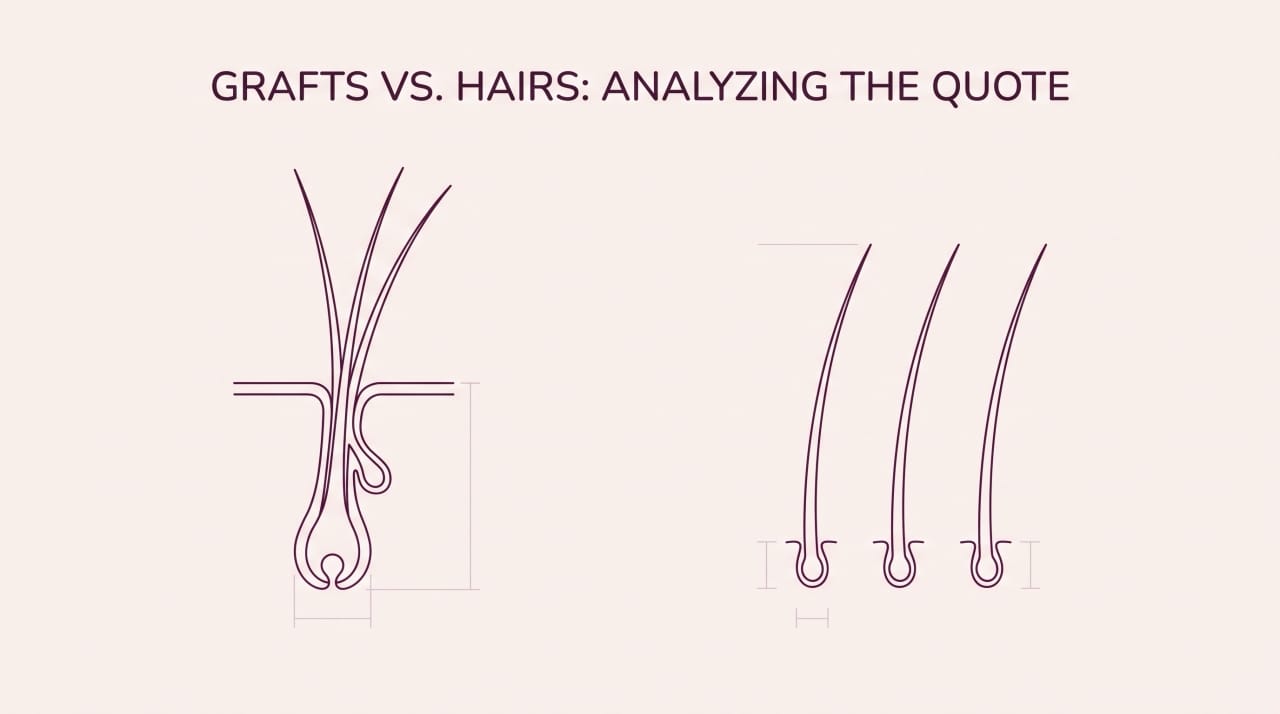
The first question to ask is whether that number refers to grafts or to hairs. These are not the same thing, and the difference is substantial.
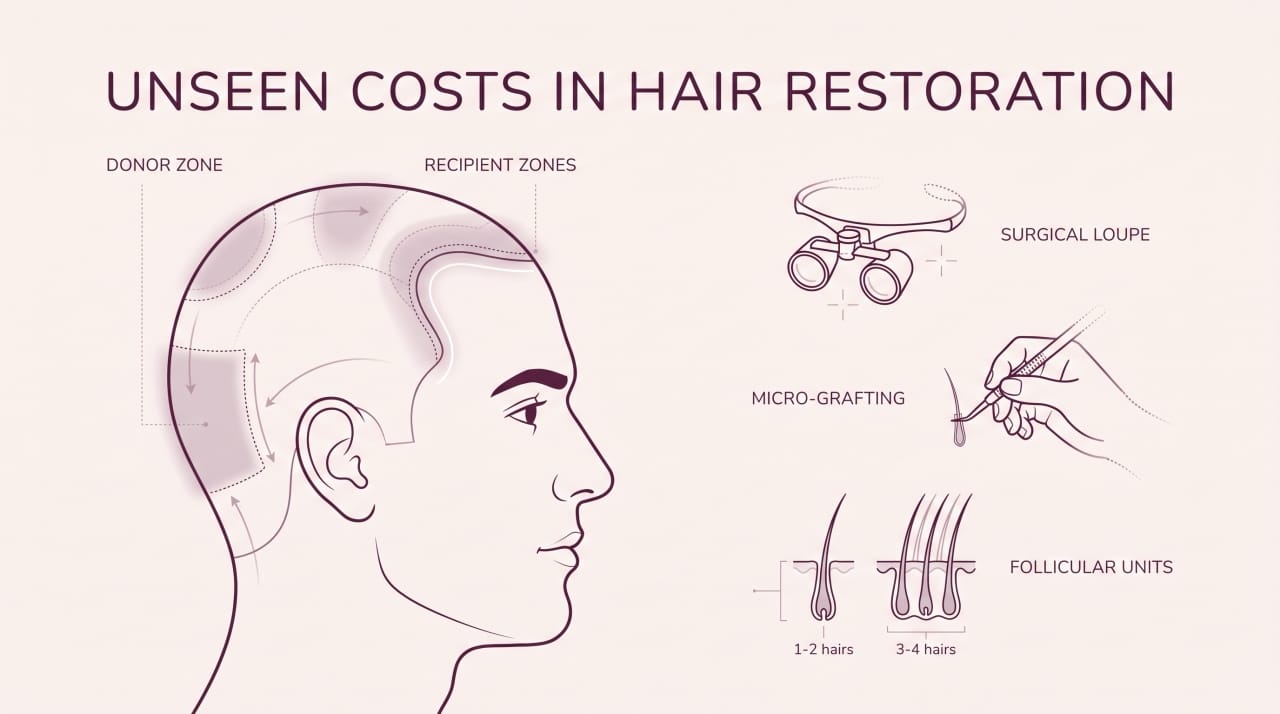
A graft is a follicular unit, the natural grouping in which hair grows out of the scalp. Depending on its location and your individual anatomy, a single follicular unit contains one, two, three, and occasionally four hairs. This means that three thousand grafts might deliver anywhere from roughly six thousand to seven thousand five hundred individual hairs, depending on the composition of your donor area.
Some clinics quote hairs. It produces a larger, more impressive number for the same amount of surgical work. A quote for six thousand hairs and a quote for three thousand grafts can describe an identical procedure, and a patient comparing the two without knowing the distinction will conclude that one clinic is offering twice as much as the other.
Ask the question directly. Is this figure grafts or hairs? If the answer is hairs, ask for the graft equivalent. If the person quoting cannot convert between the two without hesitation, that tells you something about who prepared the document.
Who Is Actually Holding the Punch
This is the single most important question in the entire process, and it is asked less often than any other.
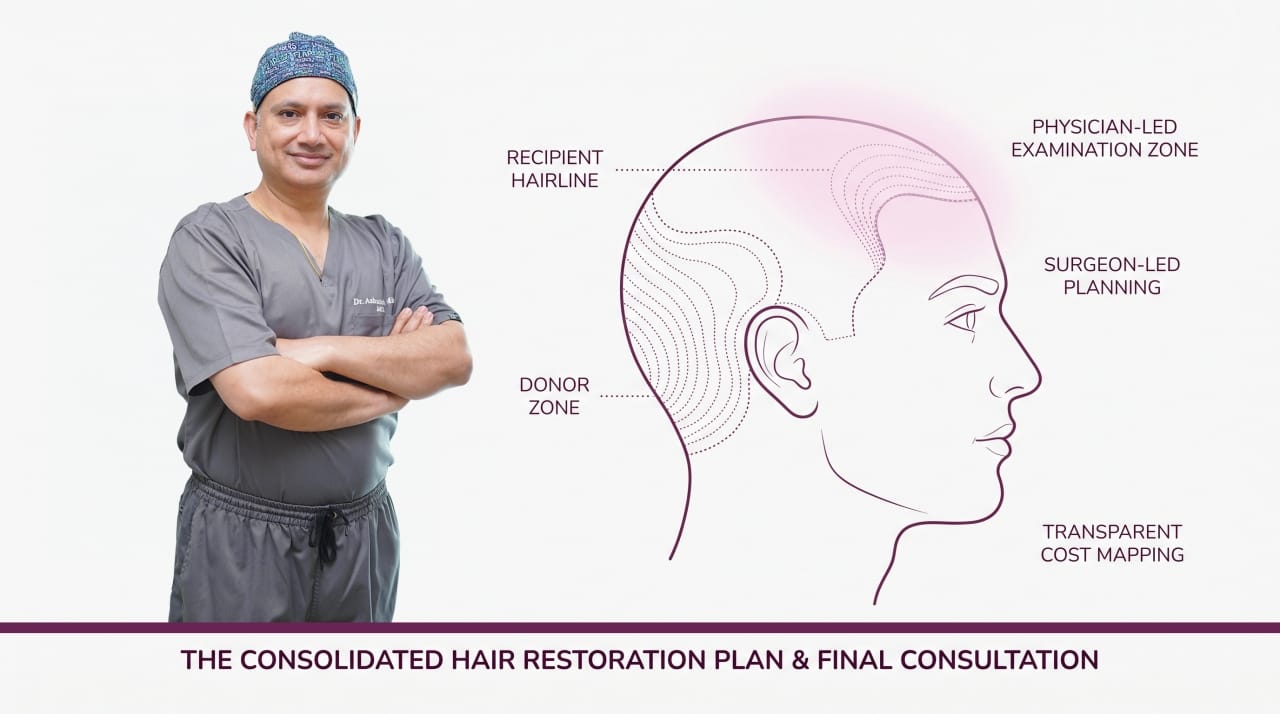
A hair transplant has two technically demanding phases. Extraction, in which each follicular unit is removed from the donor area, and implantation, in which each unit is placed into the recipient site at a specific angle, direction, and depth. In many clinics, one or both of these phases is performed largely or entirely by technicians rather than by the surgeon whose name is on the door and in the advertising.
I want to be careful here, because trained technicians are a legitimate and necessary part of a hair transplant team. A session of three thousand grafts is many hours of intensely repetitive work, and no single pair of hands does all of it. That is normal and it is not the problem.
The problem is when the surgeon's involvement is nominal. When the consultation is with a doctor, the marketing features a doctor, and the actual surgery is delegated almost entirely to staff while the doctor moves between rooms or, in some cases, is not present in the building for meaningful portions of the procedure.
This is a surgical procedure with surgical risks, performed under anaesthesia, requiring surgical judgement about vascularity, angulation, and donor management.
So the questions to ask are specific. Who designs the hairline, and are they present when it is drawn? Who makes the recipient site incisions, which determine angle and direction and therefore determine whether the result looks natural or planted? Who performs the extraction? What is the surgeon's qualification?
A clinic confident in its answer will give it plainly. Hesitation, deflection, or a reassurance that the team is highly experienced without naming who does what is itself an answer.
The Quote That Arrives Before the Examination
A significant number of quotes in this market are generated from a photograph. A patient sends images over WhatsApp, and a graft number and price arrive within hours, sometimes minutes.
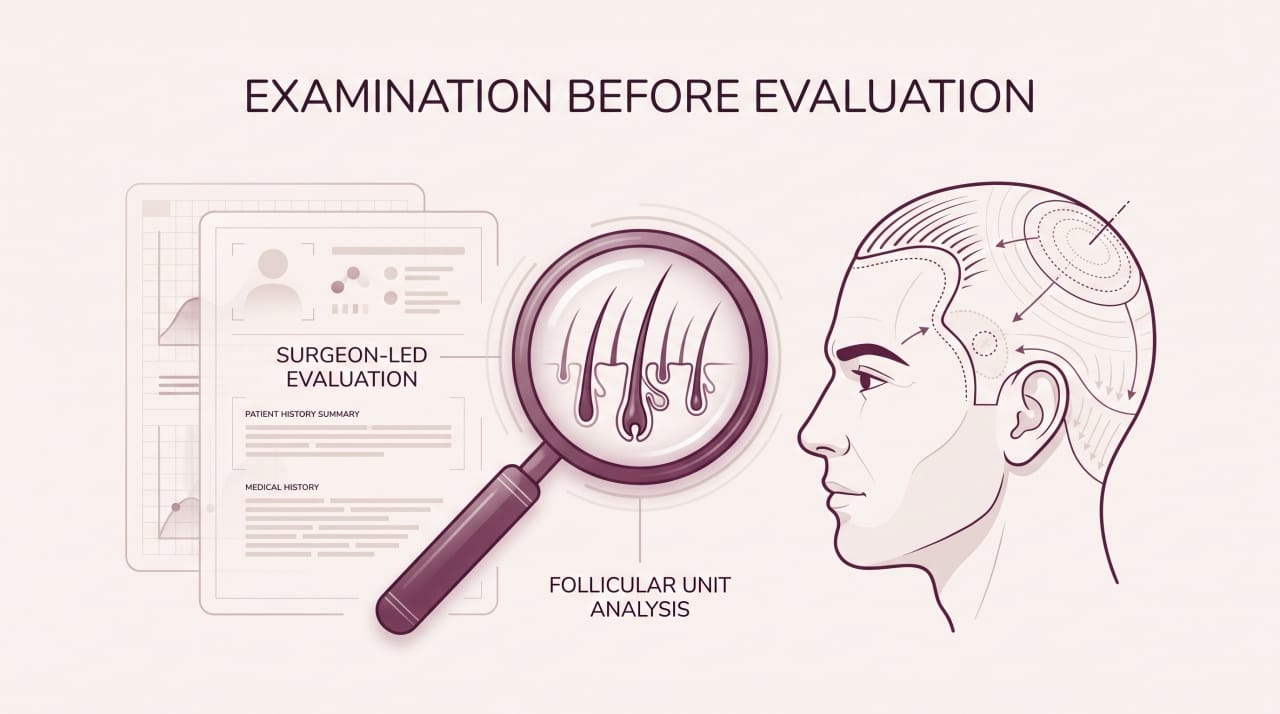
This is not an assessment. It is an estimate produced by looking at the recipient area, the part of your scalp that is thinning, and calculating what it would take to fill it.
But the recipient area is only half the equation, and it is the less important half. The determining factor in any hair transplant plan is the donor area: the density of permanent follicles on the back and sides of your head, the calibre of those individual hairs, the composition of your follicular units, and the scalp laxity that governs how much can safely be harvested.
None of this is visible in a photograph. It requires a trichoscopic examination, measurement of density per square centimetre, and an assessment of miniaturisation in the areas that are not yet obviously thinning but soon will be.
Without that assessment, a graft number is a guess dressed as a plan. It may be a reasonable guess. It may be a wildly optimistic one. There is no way for you to know, and there was no way for the person who sent it to know either.
I have written elsewhere about why the donor area is the real constraint in any hair transplant, and why a quote that ignores it is fundamentally incomplete. The short version is this: your donor supply is finite, it does not regenerate, and every graft spent today is unavailable for the session you may need at forty. A plan built without measuring that reserve is spending from an account nobody has checked.
What Per-Graft Pricing Quietly Encourages
Most quotes in Delhi are structured per graft. It appears transparent. You pay for what you receive, and a higher graft count costs proportionately more.
Consider what that structure incentivises.
If a clinic earns more by placing more grafts, the commercial pressure runs in exactly the opposite direction from good surgical planning. Good planning is conservative. It preserves donor reserve for the future, it resists placing a dense low hairline in a young patient whose loss has not stabilised, and it frequently recommends fewer grafts than a patient arrives expecting.
Per-graft pricing rewards the opposite behaviour. It rewards larger sessions, denser packing, and hairlines placed lower than they should be, because a lower hairline requires more grafts to fill.
I am not suggesting every clinic using per-graft pricing is inflating counts. Many are not. But you should understand the structure you are agreeing to, and you should be alert to a specific pattern: a quote that proposes substantially more grafts than other clinics for the same scalp, combined with a hairline design that sits noticeably lower than the ones you have been shown elsewhere.
The counter-question is simple and it reveals a great deal. Ask why this number rather than a smaller one, and what the plan is for your scalp in ten and twenty years. A surgeon planning for your lifetime will have an answer ready, because they have already done that arithmetic. A quote generated to maximise a session will not.
The Line Items That Disappear
The headline price rarely represents the total. Read for what is absent.
Anaesthesia is the first thing to check. A hair transplant is performed under local anaesthesia with tumescent infiltration, and for most patients this is entirely appropriate. But confirm who administers it and what monitoring is in place. Confirm whether sedation, if offered, involves a qualified anaesthetist and what that adds to the cost.
Then the post-operative sequence. Does the price include the first wash, which is usually done at the clinic and matters more than patients expect? The post-operative medication? The follow-up reviews at one week, one month, three months, six months, and twelve months? Growth factor or PRP sessions, if they form part of the plan, and how many?
Then the medical therapy that should accompany almost every transplant. If your loss is still active, and at most ages it is, a transplant without medical stabilisation is placing new hair into a scalp that continues to thin around it. Ask whether the plan includes finasteride or dutasteride, minoxidil, and monitoring, and whether that is costed separately.
Finally, and most importantly, ask about revision. What happens if graft survival is poor in a particular zone? What happens if the result at twelve months is not what was planned? Is there a policy, is it written down, and what does it cost? A clinic with a clear written answer has thought about it. A clinic that treats the question as vaguely offensive has not.
What the Price Difference Is Actually Buying
The spread in hair transplant pricing across South Delhi is enormous, and patients reasonably want to know what separates the bottom of the range from the top.
Some of it is genuine. Surgeon qualification and the degree of surgeon involvement. Whether the facility is a licensed operating environment with emergency provision or a converted consulting room. The number and training of technical staff, which directly affects how long grafts spend outside the body and therefore how many survive. The quality of instrumentation. Whether the session is limited to a number of grafts the team can handle well or extended to a number that keeps the schedule full.
Some of it is not genuine. Marketing spend, brand premium, and the cost of ranking at the top of a search page are all embedded in what you pay, and none of them appear on your scalp.
Your job is not to find the cheapest quote or to assume the most expensive is the best. It is to establish what each price is buying in surgical terms, and then to decide whether the difference is worth it to you.
The Questions, Consolidated
If you take nothing else from this piece, take these. Ask them in every consultation, and compare the answers rather than the numbers.
Is this figure grafts or hairs? What is my measured donor density, and what is my total lifetime donor capacity? Who designs the hairline, who makes the recipient incisions, and who performs the extraction? What is the surgeon's qualification and registration number? Why this graft count rather than fewer? What is the plan for my scalp at forty and fifty? What is included beyond the surgery itself? What is the revision policy in writing?
A clinic that answers all of these clearly may still not be right for you. But a clinic that cannot answer them has told you what you needed to know.
A Note on Where You Are Standing
The stretch of South Delhi between Greater Kailash, Lajpat Nagar, and East of Kailash contains an unusual concentration of hair restoration clinics. Some are excellent. Some are extremely good at marketing. Distinguishing between the two from the outside is genuinely difficult, and I do not think patients should be expected to manage it unaided.
What I can tell you is that the distinguishing features are almost never visible in the advertising. They are in the consultation. In whether anyone examined your donor area with an instrument rather than an eye. In whether the plan extends beyond this year. In whether the person who will operate on you is the person sitting across from you.
Read the quote. Then read the conversation that produced it. The second one tells you more.
If you would like your donor area assessed properly before anyone quotes you a number, you are welcome at Freyea Aesthetics, East of Kailash, South Delhi. We are a short distance from Kailash Colony metro and serve patients across Greater Kailash, Defence Colony, Lajpat Nagar, CR Park, Kalkaji, and Nehru Place.
Dr. Ashutosh Misra
Founder, Freyea Aesthetics | East of Kailash, South Delhi
MCh (Plastic & Reconstructive Surgery), MS (General Surgery), MBBS
25+ years of surgical experience
freyea.com