Gynecomastia Surgery in South Delhi: What Men Actually Want to Know Before They Ask
He booked the consultation four times before he came.
That is not an exaggeration or a composite detail added for effect. He told me himself, sitting down, before I had asked him anything. Three appointments made and cancelled over eighteen months. On the fourth he drove from his office near Nehru Place to East of Kailash and sat in the car park for twenty minutes before coming up.
He is thirty four. He has had this since he was about fifteen. He has never swum in front of anyone. He owns no fitted shirts. In a Delhi summer he wears an undershirt beneath a loose formal shirt because the outline is otherwise visible, and he has done this every summer for nineteen years.
And in nineteen years, the advice he received from friends, from family, from at least two doctors, was consistently the same. Lose weight. Do more chest work. It will sort itself out.
It was never going to sort itself out, and I want to explain exactly why, because the misunderstanding has cost this man two decades.
Why the Gym Was Never Going to Fix This
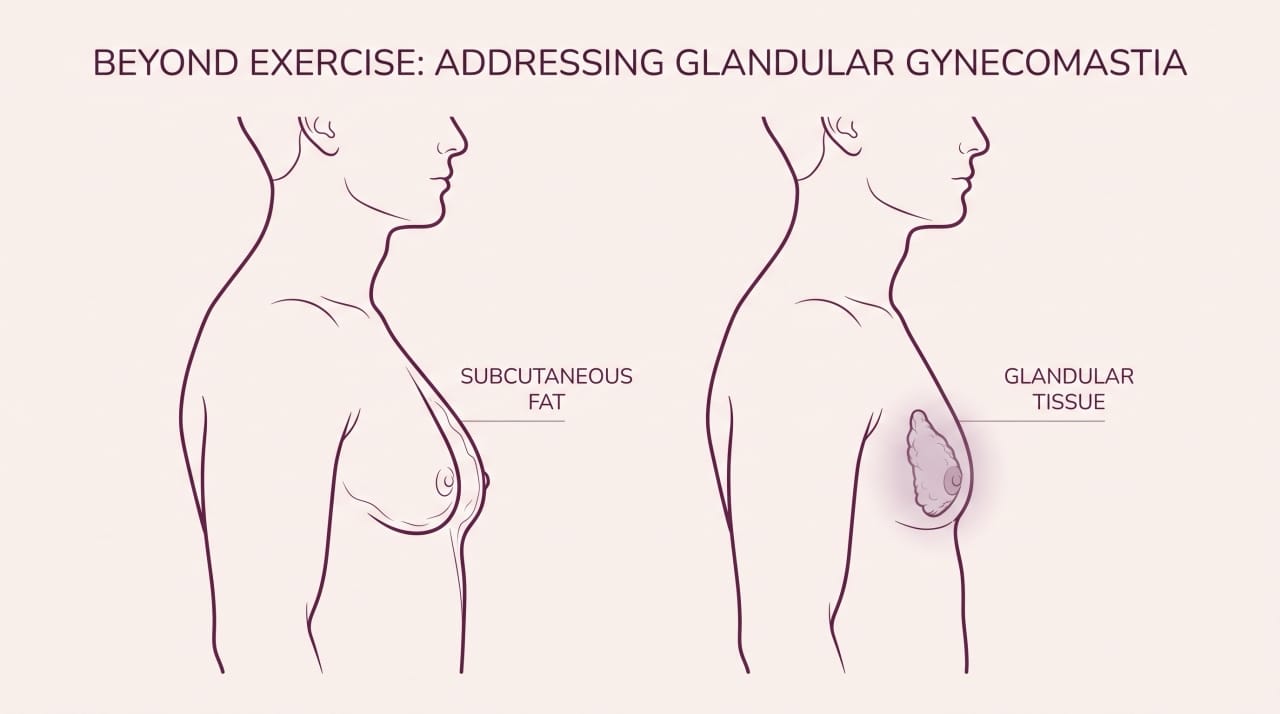
Gynecomastia is the enlargement of male breast tissue. The critical word in that sentence is tissue, because what is present is not necessarily fat.
There are two distinct things that can create fullness in the male chest, and they behave completely differently.
The first is fat. Excess subcutaneous fat over the pectoral region, sometimes called pseudogynecomastia, is soft, diffuse, and distributed across the chest. It is metabolically ordinary fat and it does respond, at least partially, to sustained weight loss.
The second is glandular tissue. This is firm, rubbery, disc-shaped, and sits directly beneath and around the nipple areolar complex. It is breast tissue in the anatomical sense, and it developed because of a hormonal signal, most commonly the oestrogen to androgen shift of puberty.
Glandular tissue does not respond to weight loss. Not partially. Not eventually. It is not a fat store, it does not participate in caloric metabolism, and no amount of caloric deficit will remove it. A man can reach single digit body fat, with visible abdominal definition, and still have a firm palpable disc beneath each nipple, because that tissue was never going to be affected by anything he did in a gym.
This is why the advice failed. It was not that he did not try hard enough. It is that he was given a treatment for the wrong condition, repeatedly, by people who meant well and did not know the difference.
Most cases are mixed, with both fat and gland present in varying proportions. That mixture is what determines the operation.
Why the Distinction Changes Everything
An examination that distinguishes gland from fat takes under a minute. You pinch the tissue around and beneath the areola and you feel for the disc. Firm and discrete means gland. Soft and diffuse means fat.
It matters because it determines the surgical technique, and getting it wrong produces the single most common unsatisfactory outcome in this operation.
Liposuction removes fat. It is excellent at removing fat. It cannot remove glandular tissue, because glandular tissue is fibrous and dense and does not aspirate through a cannula.
So if a man with significant glandular tissue undergoes liposuction alone, here is what happens. The surrounding fat is removed, the chest becomes flatter overall, and the firm glandular disc, now unsupported by the fat that used to blend it into the surrounding contour, becomes more prominent rather than less. He is left with a visible mound directly behind the nipple, sitting on an otherwise flat chest. In some cases it looks worse than before surgery.
This outcome is not rare. It is one of the most common reasons men come to me for revision. And it is almost always the consequence of an operation that treated the fat and ignored the gland.
Proper correction requires excision of the glandular tissue, usually through a small incision at the lower border of the areola where the scar is concealed by the colour transition, combined with liposuction of the surrounding fat to blend the contour. Two techniques, addressing two different tissues, in one operation.
What the Grades Actually Mean
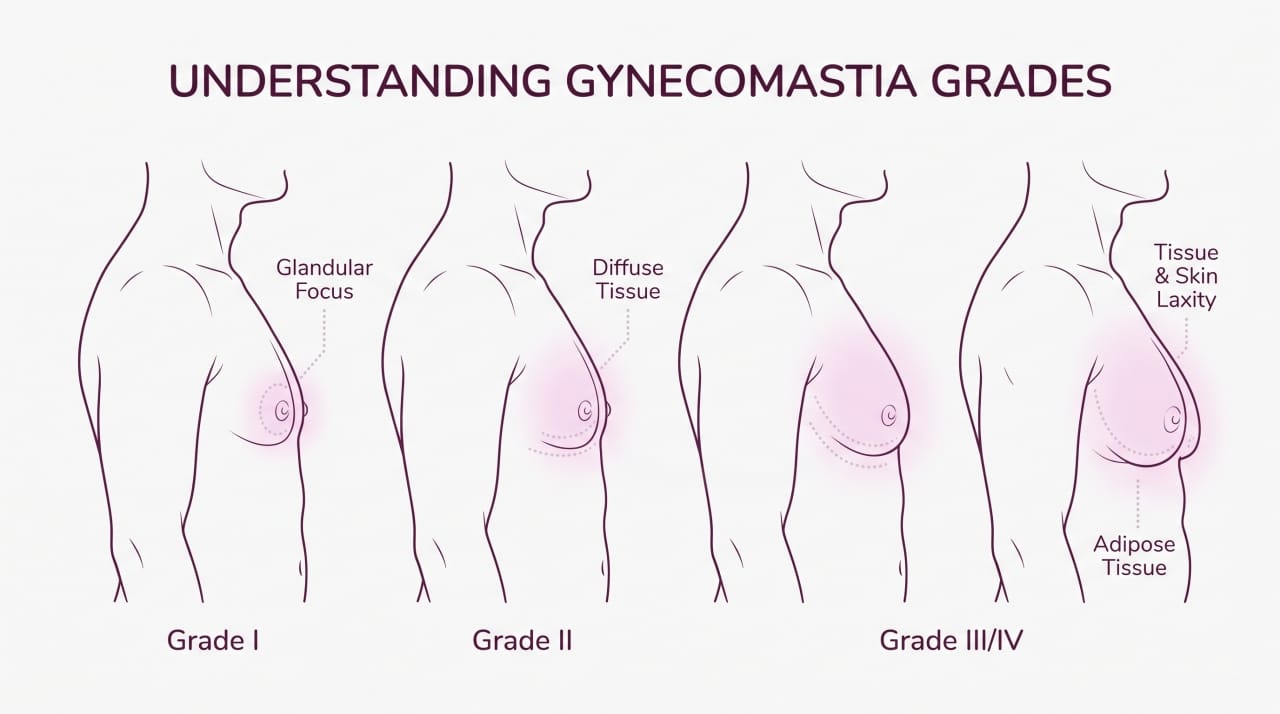
Gynecomastia is commonly graded, and the grade determines both the complexity of the surgery and what your realistic result looks like.
In the mildest presentation there is minor enlargement confined to the area around the areola, with no excess skin. Correction is straightforward: gland excision with limited liposuction, small scar, quick recovery, excellent result.
At the moderate stage the enlargement extends beyond the areola but the skin still has enough elasticity to retract over the reduced contour. This is the most common presentation I see in men in their twenties and thirties, and it is highly correctable through the same periareolar approach with more extensive liposuction.
The picture changes when moderate enlargement is accompanied by genuine skin excess. Here the skin will not retract fully on its own, and correcting the gland and fat alone leaves loose tissue. Some skin tightening becomes necessary, which means a longer scar.
In the most advanced presentation there is marked enlargement with significant skin redundancy and a downward displaced nipple position. This requires skin excision and repositioning of the nipple areolar complex, and the scars are correspondingly more extensive. The trade is real and it needs to be discussed honestly: a flat chest with visible scars, or the current situation. Most men choose the first, but they should choose it knowing what it involves.
The grade is not a judgement. It is a description of what needs to be addressed, and it exists so that the plan matches the anatomy.
What Recovery Actually Looks Like
Men ask about this more anxiously than any other aspect, largely because they are planning how to disappear from view for as short a time as possible.
The surgery is a day procedure. Depending on grade and the extent of work required, it takes between one and three hours, usually under general anaesthesia or heavy sedation with local infiltration.
You will wear a compression vest continuously for four to six weeks. As with any body contouring procedure, this is not optional and it directly affects your final contour.
Desk work is realistic within three to five days for most men. Driving within about a week. Light lower body exercise at two to three weeks. Upper body and chest training at six weeks, and not before, because early chest work risks bleeding, fluid collection, and disruption of the healing contour.
Swelling obscures the result for the first several weeks. The chest looks flat immediately after surgery, then swells, then gradually settles. The genuine result appears at around three months, and the scar continues to fade for a year.
Complications are uncommon but real, and you should hear them named. Haematoma, which is a collection of blood requiring drainage, is the most frequent early problem. Contour irregularity, particularly if the excision was uneven. Over-excision, which produces a saucer-like depression behind the nipple and is considerably harder to correct than under-correction. Temporary or occasionally permanent nipple numbness. Asymmetry, which to some degree exists in every chest before surgery and may persist after it.
Recurrence, if the glandular tissue has been properly excised, is rare. This is a one-time operation for most men. It can return if the underlying cause persists, particularly with continued anabolic steroid use, which is worth naming plainly because it is a common and under-disclosed factor in men presenting in their twenties and thirties.
Reading the Price Gap
Quoted costs for gynecomastia surgery in Delhi vary widely. Figures starting around fifty five thousand rupees circulate, while many established practices quote between eighty thousand and one and a half lakh, and complex cases exceed that.
A spread that wide is not random, and you should understand what sits inside it.
The most important variable is whether gland excision is actually included. A quote based on liposuction alone will be cheaper and, for a man with significant glandular tissue, will not solve his problem. Ask explicitly whether the gland is being excised or only the fat.
Then the grade. A grade one correction and a grade three correction with skin excision and nipple repositioning are different operations with different theatre times, and pricing them similarly would make no sense.
Then anaesthesia. Whether a qualified anaesthetist is present, and what form of anaesthesia is planned, materially affects both cost and safety.
Then the facility. A licensed operating theatre with emergency provision costs more to run than a procedure room, and that difference appears in your quote.
Then the surgeon's qualification. You are entitled to ask what that training is and to verify the registration.
And finally the things quietly omitted: the compression vest, post-operative medication, follow-up reviews, and the revision policy if the contour needs refinement. Ask for the revision policy in writing before you pay anything.
Insurance generally does not cover this, as it is classified as cosmetic in most policies. In cases with documented pain or a clear underlying pathology there is occasionally partial coverage, but you should not plan around it.
The Thing Nobody Says Out Loud
I want to end away from the clinical detail, because the clinical detail is not why men delay this for a decade.
Gynecomastia occupies a peculiar position. It is common, affecting a substantial proportion of men at some point. It is entirely correctable, with a well established operation and a high satisfaction rate. And it is almost never discussed, because the thing it affects is a part of the male body that men are not supposed to have feelings about.
So men manage it privately for years. They develop a wardrobe strategy. They decline invitations that involve water. They keep an undershirt on through a Delhi June. They construct an entire architecture of small avoidances, and because each individual avoidance seems minor, the cumulative cost is never fully counted.
The man I described at the start told me, after his surgery, that the thing that surprised him was not how his chest looked. It was that he stopped calculating. He walked into a room without first working out where he would stand and what angle he would be seen from. He said the calculating had been running in the background so long he had forgotten it was there.
That is the actual result of this operation. The contour is what we correct. The calculating is what stops.
If you have been managing this quietly, you do not need to justify wanting it addressed, and you do not need to have tried harder at the gym first. It was never a gym problem. It was a tissue problem, and tissue problems have surgical answers.
If you would like a straightforward examination and an honest assessment of what is gland and what is fat, you are welcome at Freyea Aesthetics, East of Kailash, South Delhi. Consultations are private, unhurried, and we see men from across Greater Kailash, Defence Colony, Lajpat Nagar, CR Park, Kalkaji, Nehru Place, and the Okhla corridor.
Dr. Ashutosh Misra
Founder, Freyea Aesthetics | East of Kailash, South Delhi
MCh (Plastic & Reconstructive Surgery), MS (General Surgery), MBBS
25+ years of surgical experience
freyea.com