Breast Reduction in Delhi: Why It Has One of the Highest Satisfaction Rates in Surgery

There is a question I have learned not to ask first.
It is the obvious one, the one most patients arrive braced to answer, and the one almost every consultation in this field opens with. What size would you like to be?
I understand why it gets asked. It is concrete, it sounds like planning, and it produces a number that can be written down. But it aims at the wrong thing, and over twenty five years I have come to believe that asking it first is the most common reason breast reduction consultations go wrong.
The question I ask instead is this. What are your breasts stopping you from doing comfortably?
The answers I get to that question are what this entire operation is actually about, and they explain why breast reduction sits where it does in the satisfaction data.
What the Numbers Show
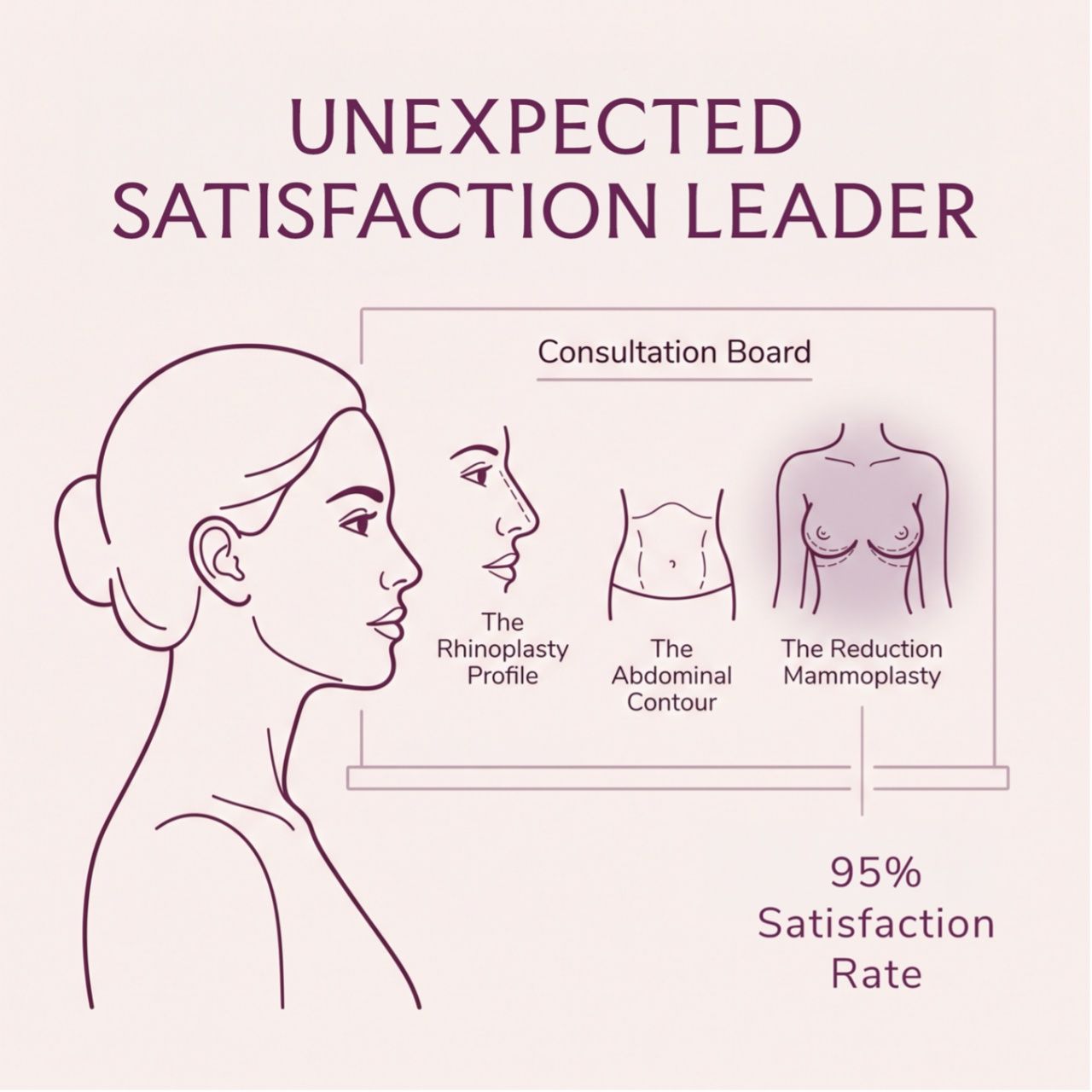
Breast reduction, known clinically as reduction mammaplasty, consistently reports patient satisfaction above ninety percent, with measurable quality of life improvement appearing within three months of surgery and holding at twelve months.
In research using the BREAST-Q, the validated instrument for measuring patient reported outcomes in breast surgery, improvements in satisfaction with appearance, psychosocial wellbeing, and physical wellbeing appear as early as six weeks after the operation.
There is one further finding I keep returning to. A BREAST-Q analysis examining whether postoperative complications reduce satisfaction found that complication status was not a significant predictor of patient dissatisfaction. Women who experienced delayed wound healing, seroma, infection, or asymmetry needing correction reported satisfaction broadly comparable to women whose recovery was uneventful.
That is unusual. In most operations I perform, a complication is the single most reliable predictor of an unhappy patient. Here it barely moves the result.
The explanation is not that the surgery is easy or that complications do not matter. It is that the problem being solved is so substantial, so daily, and so long endured that a few additional weeks of dressings does not register against it.
What She Has Actually Been Carrying
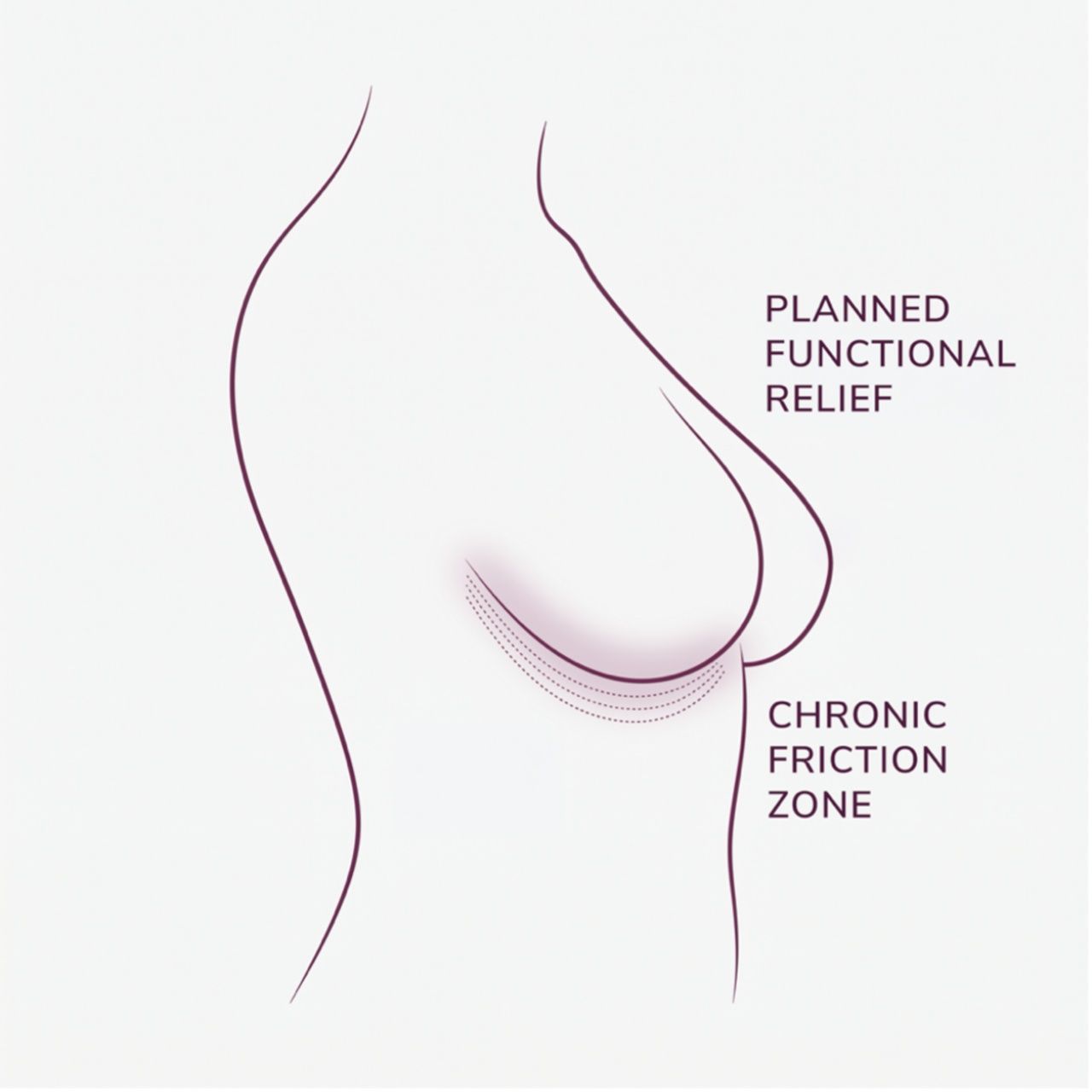
When I ask what the breasts are preventing, the answers arrive in a particular order, and they are almost never about appearance.
Exercise, usually first. Running has stopped, or was never possible. The gym is uncomfortable. Yoga involves positions she avoids. This has downstream effects on weight, cardiovascular health, and mood that accumulate quietly over years.
Clothing, usually second. Buying anything that buttons requires either tailoring or resignation. Fitted clothes are out. She dresses to conceal rather than to choose, and has done so for so long that she no longer registers it as a limitation.
Then posture and pain. Chronic neck, shoulder, and upper back discomfort, frequently treated for years with physiotherapy that relieves the strained muscles without addressing the load straining them. Deep grooves where bra straps carry weight, sometimes with permanent skin change. Headaches originating in cervical strain. Numbness or tingling in the fingers from pressure on the brachial plexus, which is often investigated as a neurological problem before anyone examines her shoulders.
Then comfort, which in Delhi has a specific and seasonal meaning. Intertrigo, the inflammatory rash that develops in the fold beneath the breast where skin sits against skin in heat and moisture, is not a minor irritation here. From April through September it is a raw, recurring, sometimes infected problem managed with powders and antifungals that contain it without ever resolving it, because the anatomy producing it has not changed.
And then sleep. Most of my patients cannot sleep on their front and have not been able to for many years.
Most women I operate on have lived with all of this for somewhere between fifteen and thirty years. Most have been told at some point that losing weight would solve it. For the majority it does not, because breast tissue does not reduce proportionally with overall weight loss, and a woman can lose fifteen kilograms and find her back pain essentially unchanged.
Why That Changes How I Plan the Operation
If the goal were simply to be smaller, the operation would be straightforward volume removal. It is not, and this is the part of breast reduction that is most often misunderstood.
Reduction mammaplasty is closer to a reconstruction than to a removal. Three things happen, and only one of them is taking tissue out.
The first is volume reduction, calibrated to the individual. Not to a cup size, which is an unreliable and inconsistent measure, but to what her frame, her height, her shoulder width, and her torso length will carry comfortably. The correct volume for a woman of five foot two with a narrow frame is not the correct volume for a woman of five foot nine with broad shoulders, even if both arrive describing the same complaint.
The second is reshaping. Heavy breasts do not simply have too much tissue, they have tissue that has descended and redistributed under its own weight over many years. Removing volume without reshaping produces a smaller version of the same shape. The tissue that remains has to be reorganised into a breast that sits where it should.
The third is repositioning. The nipple areolar complex sits low on a heavy breast, sometimes considerably below the inframammary fold. It has to be moved to a natural height on the newly shaped breast, and it has to be moved without interrupting its blood supply or its nerve supply. This is done by leaving the nipple attached to a pedicle, a preserved column of tissue, while the tissue around it is removed. The choice of pedicle, most commonly superomedial or inferior, is one of the significant technical decisions in the operation and it affects sensation, shape, and long term projection.
Proportion is the governing idea across all three. The aim is not a number. It is a breast that suits the specific woman it belongs to, which is why two patients with identical resection weights can require quite different operations.
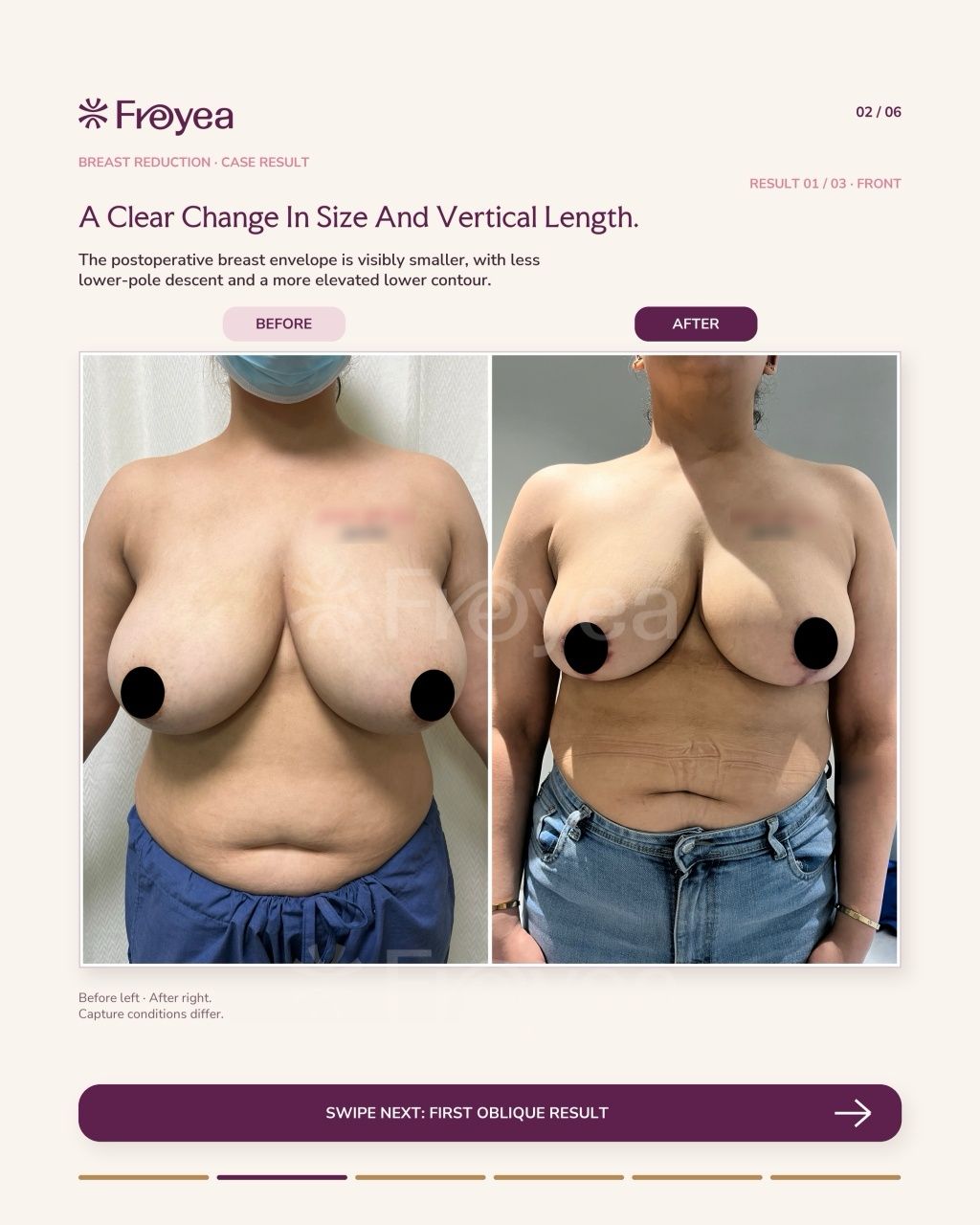
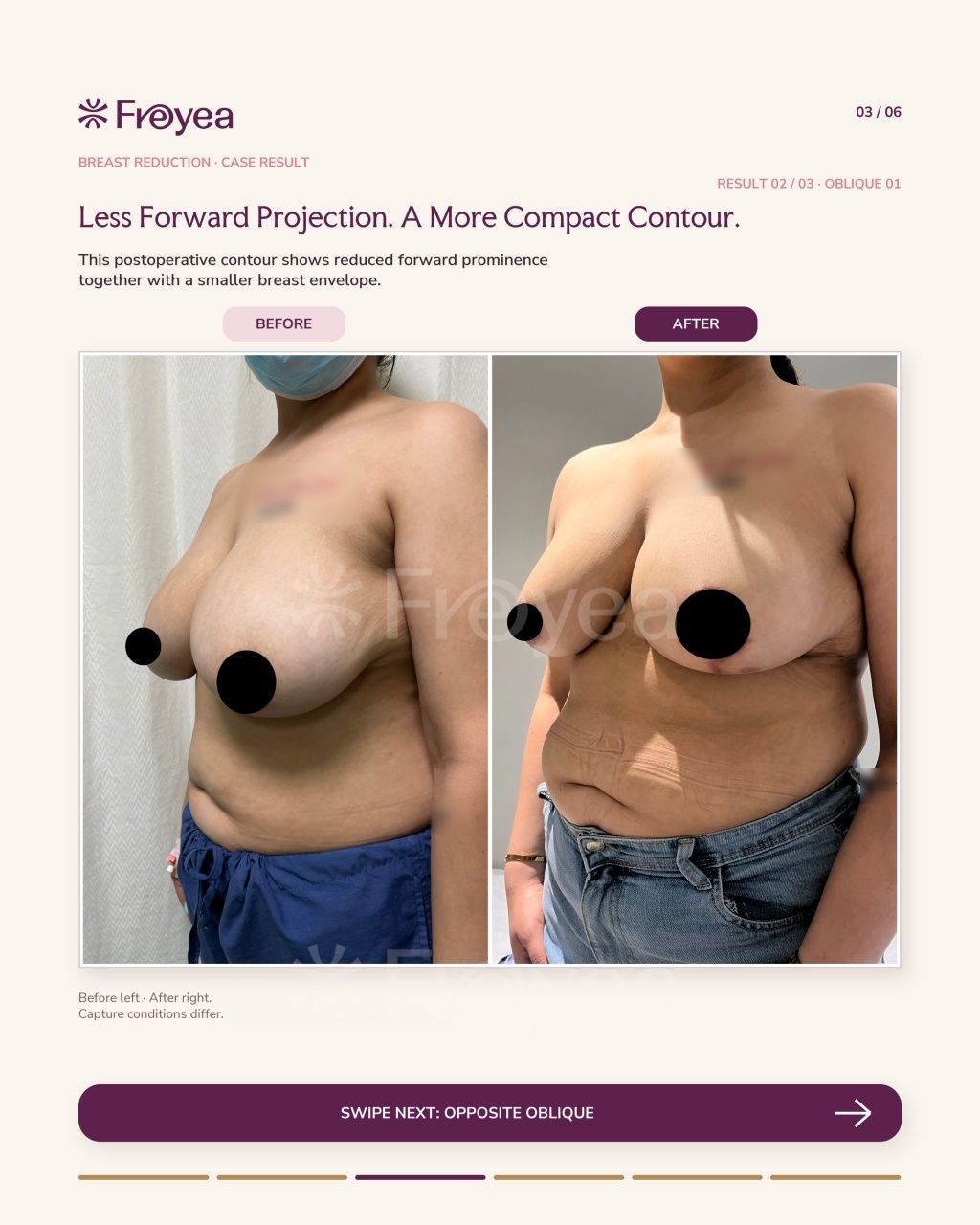
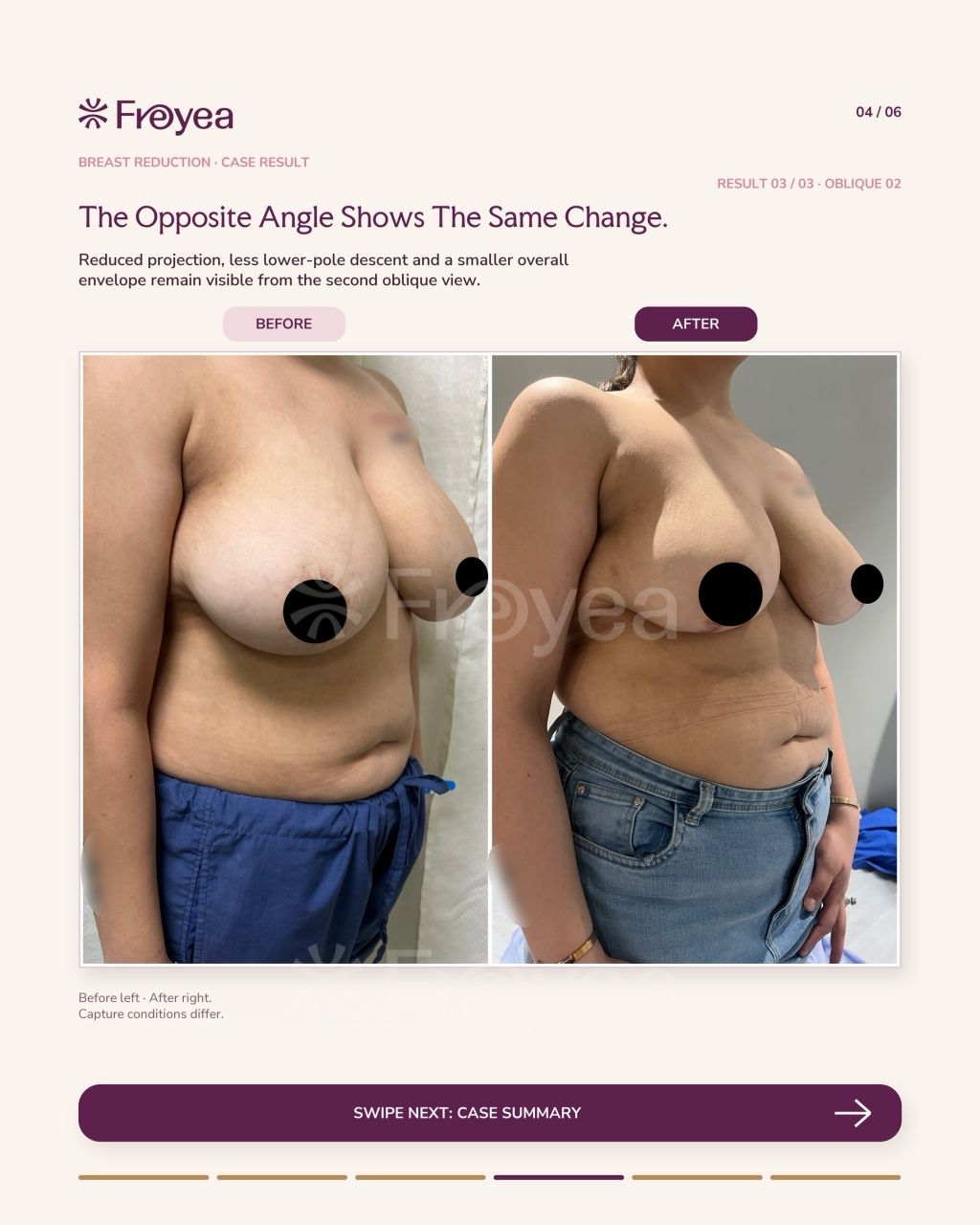
Clinical results: front and oblique reduction contour. Tap any image to expand.
The Trade-Offs, Said Plainly
I want to be direct about these, because a satisfied patient is almost always a well informed one, and the research supports this. Studies looking at cosmetic satisfaction after reduction found that the quality of information given and the patient's confidence before surgery correlated with how well she rated her outcome.
There will be scars
This is the central trade of the operation and it is permanent. The scar pattern depends on how much tissue has to come out. A vertical pattern, sometimes called a lollipop, leaves a scar around the areola and a vertical line down to the fold, and suits moderate reductions. Larger reductions usually need a Wise pattern, which adds a horizontal scar along the inframammary fold, producing the inverted T or anchor shape.
These scars fade substantially over twelve to eighteen months, and in most women they become pale and flat, with the horizontal component sitting largely in the natural shadow of the breast fold. But they do not disappear, and any surgeon who implies otherwise has not prepared you honestly.
Recovery takes time
Surgery takes two to four hours under general anaesthesia, usually as a day case or with one overnight stay. A supportive surgical bra is worn continuously for four to six weeks. Most women return to desk work at around two weeks, some need three. Driving at two to three weeks. No lifting above shoulder height or significant exertion for four to six weeks. Full exercise, including running, at six to eight weeks.
The most common minor complication is delayed healing where the vertical and horizontal scars meet, which carries the most tension and the most marginal blood supply. It is managed with dressings and adds a few weeks.
Final shape settles over six to twelve months as swelling resolves and tissue relaxes.
Sensation can change
Nipple sensation is commonly altered after reduction, usually temporarily. Most women regain normal or near normal sensation over six to twelve months. A minority experience permanent change, either reduced or occasionally increased sensitivity. Pedicle technique influences this and it is a reasonable thing to ask about specifically.
Breastfeeding cannot be guaranteed
Modern pedicle techniques preserve a substantial portion of the ductal system and its connection to the nipple, and many women breastfeed successfully afterwards. But capacity may be reduced and success cannot be promised. In very large reductions requiring a free nipple graft, breastfeeding is essentially eliminated.
If you have not completed your family and breastfeeding matters to you, this belongs at the centre of the conversation rather than at its edge. For some women that means proceeding with full information. For others it means waiting, and waiting is a legitimate choice rather than a failure of nerve.
Planning It Around a Delhi Year
Timing: Your Environment Matters More Than the Month
There is a piece of local advice about timing that I want to state more precisely than it is usually put.
You will wear a supportive compression garment continuously for four to six weeks, and compliance with it directly affects how evenly your final shape settles. The question that actually matters is not which month you book. It is what your days will look like during those weeks.
If you work and recover in a controlled indoor environment, this operation can be scheduled at any point in the year. A desk based role in an air conditioned office, a home you can keep cool, a commute that is short or air conditioned, work you can do sitting down. Under those conditions a Delhi June is no harder than a Delhi December, and there is no reason to postpone.
The picture changes if your days involve being outside. Field work, site visits, travel between locations in the heat, teaching or retail in a space without reliable cooling, a long commute on a two wheeler or by public transport, or a household routine that keeps you moving in and out of an uncooled space. Wearing continuous compression through that in April, May, or June is genuinely difficult, and I have had this conversation enough times to know how it usually ends. The garment hours quietly reduce, and the shape settles less evenly than it should have.
The monsoon carries a version of the same problem. Sustained humidity under a garment worn against healing skin raises the risk of irritation in the fold, which is the same area that was likely giving you trouble before surgery.
So look honestly at your working and living conditions for the six weeks after the operation rather than at the calendar. If they are indoors and controlled, choose whichever month suits your life. If they are not, either schedule into the cooler months or make the arrangements that will let you comply properly: air conditioning where you will spend most of your recovery, a second garment so one can be washed and dried, and a realistic conversation with your employer about what you can and cannot do during that period.
Less Restricted, Rather Than Simply Smaller
I ask every patient at her six month review what changed.
Almost nobody leads with appearance.
They talk about sleeping on their front for the first time in twenty years. About buying a shirt in an ordinary shop without planning the trip around it. About running, which several describe with something close to disbelief, as though a capacity had been revoked and then quietly returned. About the absence of a low background ache they had stopped noticing because it had been there since school. About not adjusting a strap. About the grooves in their shoulders filling in over the following months, which women mention often and which seems to carry particular weight.
And about a certain kind of attention stopping, which is spoken about carefully and matters enormously.
This is why the satisfaction figures look the way they do. Not because the operation is simple, and not because the trade-offs are trivial, but because for the right patient this was never about becoming smaller. It was about no longer being restricted by something she has carried, without much discussion and without much choice, for a very long time.
If any part of this description matched your experience, you do not need to justify wanting it addressed, and you do not need to have tried harder first. What you are describing is a mechanical load problem with documented physical consequences. The fact that it involves breasts rather than knees does not make it cosmetic.
Consultations in East of Kailash, South Delhi
We see patients for breast reduction at our clinic in East of Kailash, a short distance from Kailash Colony metro on the Violet Line and easily reached from Greater Kailash I and II, Defence Colony, Lajpat Nagar, CR Park, Kalkaji, Jangpura, Nehru Place, and Sarita Vihar.
Consultations are unhurried and private. There is no expectation that you arrive with a target size in mind, and if you do not want to discuss appearance at all in the first meeting, that is entirely workable. We can begin with what is uncomfortable and work backwards to the surgery from there.
Freyea Aesthetics
F-46, East of Kailash
New Delhi 110065, India
Dr. Ashutosh Misra, MCh (Plastic & Reconstructive Surgery), MS, MBBS
freyea.com