Breast Lift or Implants: The Question Most Consultations Get Wrong

She came in asking for implants, and she was very clear about it. She had done the research, she knew the sizes, and she had a figure in mind.
What she described, when I asked her to explain the problem rather than the solution, was this. Her breasts had lost fullness after two children. They looked flat at the top. They sat lower than they used to. In a bra they looked fine. Out of one they looked, in her words, empty and low.
That description contains two separate problems, and an implant only addresses one of them.
This is the most common misdiagnosis in breast surgery, and it is a misdiagnosis that frequently survives the consultation, because the patient asks for implants, the surgeon provides implants, and nobody establishes whether volume was actually the problem.
Two Problems That Feel Like One
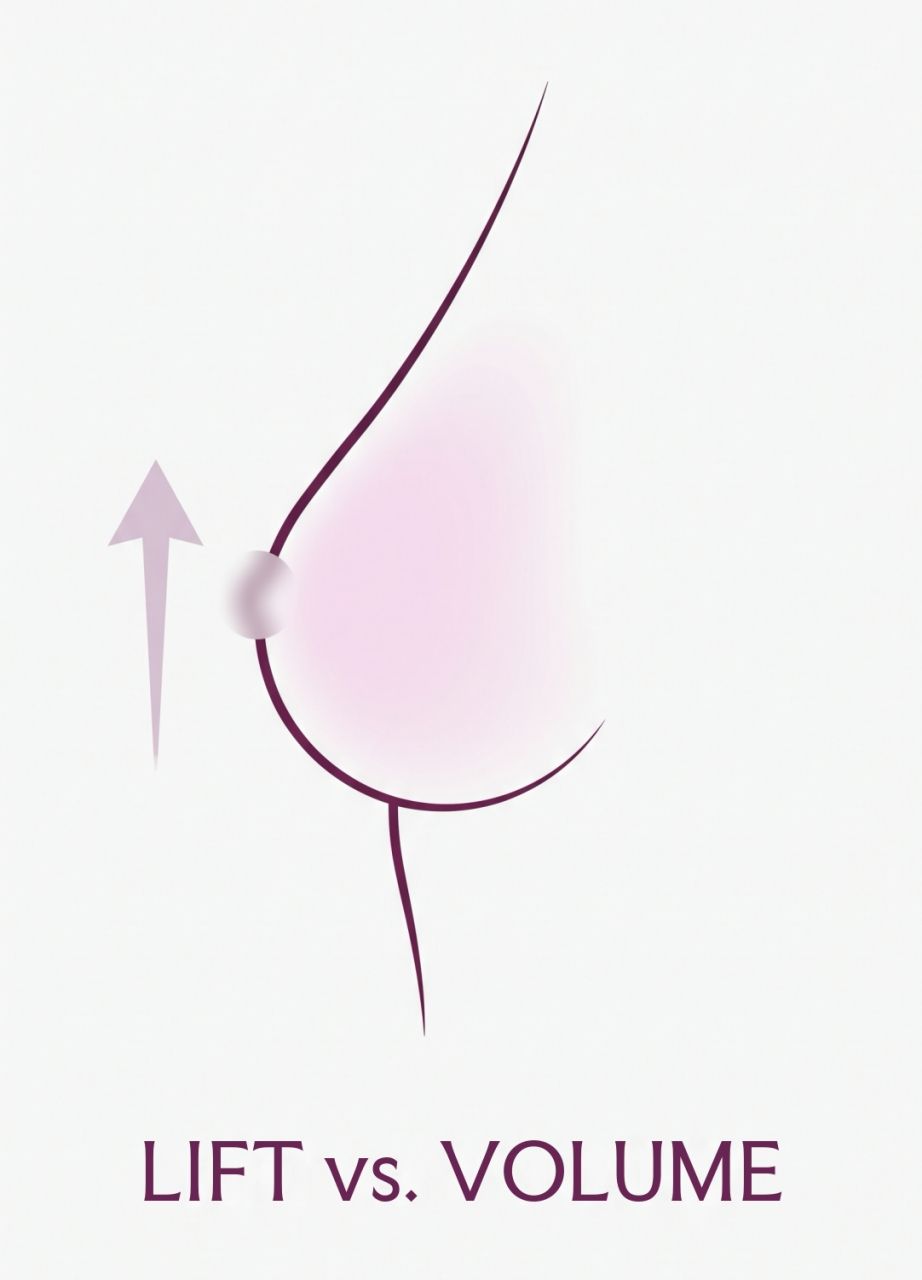
A breast can change in two independent ways, and most women experience both at once, which is why they are so easily conflated.
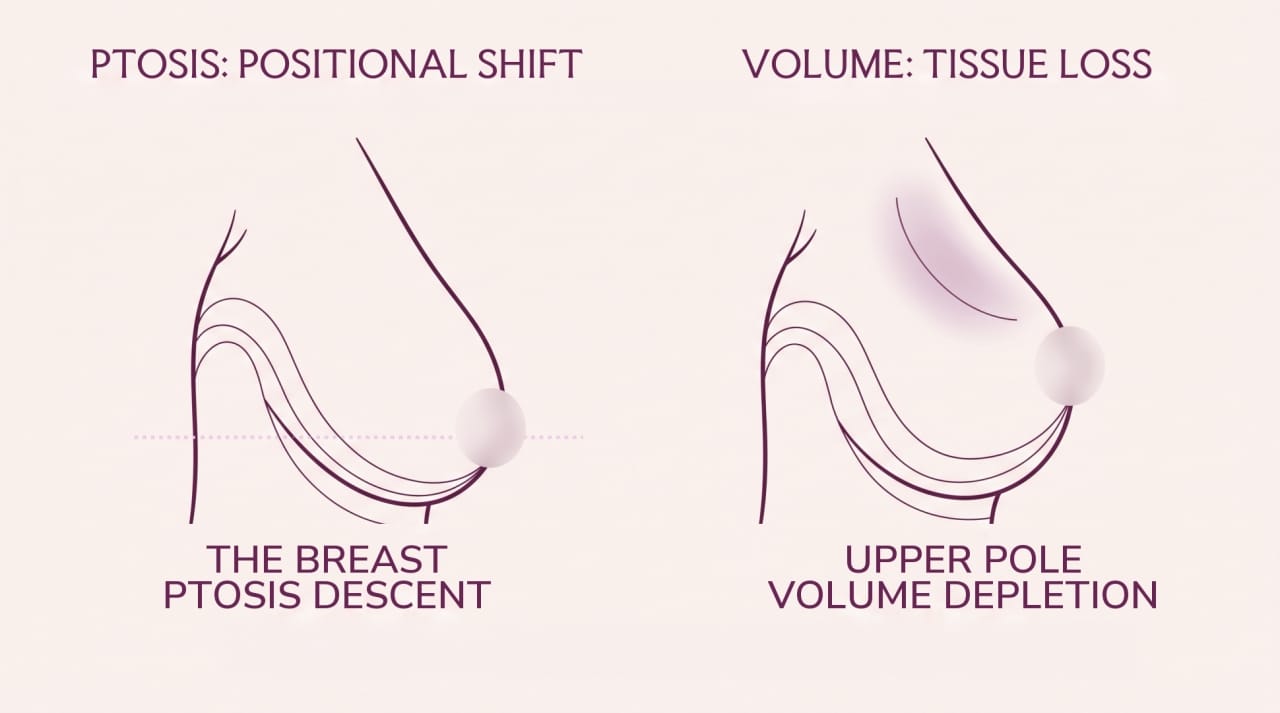
The first is volume loss. The breast contains less tissue than it did. After pregnancy and breastfeeding the glandular tissue involutes, and many women find their breasts settle at a smaller volume than before. Significant weight loss does the same thing. The breast is smaller, and in particular the upper pole, the area above the nipple, loses its fullness and looks flat or hollow.
The second is descent. The breast sits lower on the chest wall than it did, and critically, the nipple sits lower too. This is ptosis. It is caused by stretching of the skin envelope and the internal support structures, and it is not the same thing as having less tissue.
Volume loss is a content problem. Ptosis is a position problem. An implant solves the first. Only a lift solves the second.
And here is why it matters so much: an implant placed into a significantly ptotic breast does not raise it. It adds volume to a breast that is still sitting low, which means the breast becomes larger and still sits low. In pronounced cases the implant settles high on the chest while the natural breast tissue hangs below it, producing a double contour that is considerably harder to correct than the original problem.
The Measurement That Decides It
There is one measurement that answers this question, and it takes about ten seconds.
The inframammary fold is the crease where the lower edge of the breast meets the chest wall. Its position is relatively fixed. The question is where your nipple sits in relation to it.
If the nipple sits above the fold, the breast has not meaningfully descended. Volume loss may well be the main problem, and an augmentation alone can produce a good result.
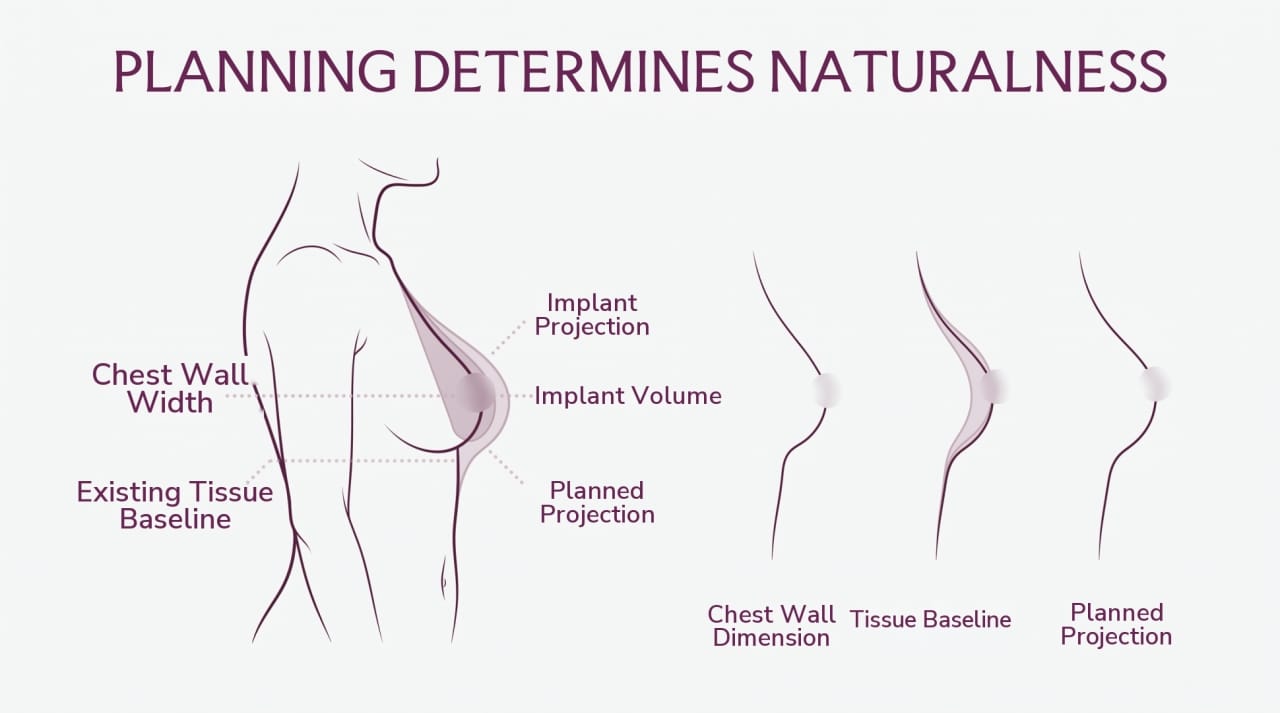
If the nipple sits at the level of the fold, you are at the boundary. This is mild ptosis, and whether an implant alone will suffice depends on skin quality, the amount of tissue present, and how much volume is being added, because a larger implant can sometimes fill a stretched envelope adequately.
If the nipple sits below the fold, the breast has descended and an implant alone will not correct it. This is moderate to severe ptosis depending on how far below, and it needs a lift.
There is a fourth pattern worth naming because it is extremely common after breastfeeding. The nipple sits above the fold, but the breast tissue below it has dropped and the lower pole hangs. This is pseudoptosis. The nipple is in an acceptable position but the breast has emptied downward, and it often needs a lift of a limited kind, or a lift combined with a small implant to restore the upper pole.
In consultation I measure this directly, along with the distance from the sternal notch to the nipple and from the nipple to the fold. Those three figures largely determine the answer, and they can be taken in under a minute.
What a Lift Actually Does
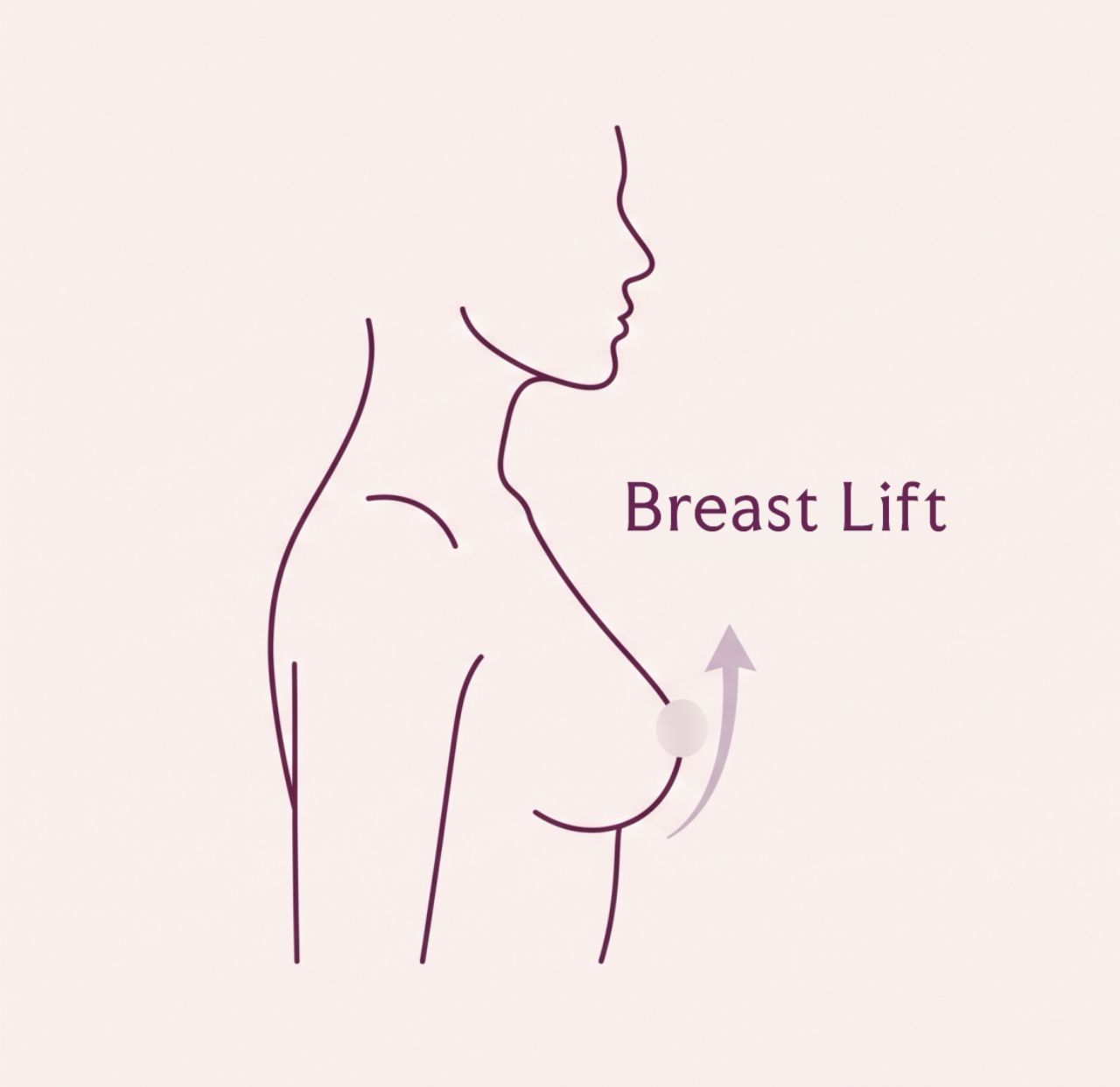
A mastopexy does not remove a significant amount of breast tissue. It repositions what is there.
The surgeon removes excess skin, reshapes the remaining breast tissue into a higher and more projected position, and moves the nipple areolar complex up to a natural height on the reshaped breast. As in a reduction, the nipple remains attached to a pedicle that carries its blood supply and nerve supply, so it is relocated rather than detached.
The scar pattern depends on how much lift is needed. A limited correction can sometimes be achieved through a scar around the areola alone. A moderate lift usually requires a vertical scar running from the areola down to the fold, the lollipop pattern. A substantial lift needs the anchor pattern, which adds a horizontal scar along the fold itself.
This is where the honest conversation has to happen, because the scar burden is the real difference between the two operations.
The Trade Nobody States Clearly
An augmentation involves one short scar, usually around four to five centimetres, placed in the inframammary fold where it is well concealed. Recovery is relatively quick. The visible evidence of surgery is minimal.
A lift involves considerably more scarring. Around the areola at minimum, usually a vertical component, often a horizontal one as well.
I believe this difference, more than anything clinical, is why women arrive asking for implants. Implants are the option with fewer scars, and when the choice is presented as a preference rather than a diagnosis, almost anyone would choose fewer scars.
But it is not a preference. If your nipple sits below your fold, choosing implants to avoid scars means choosing a larger breast that still sits low. The scars you avoided are replaced by a shape problem that is harder to live with and harder to correct.
So I present it as what it is. Here is where your nipple sits. Here is what each operation can and cannot do about that. Here is the scar each involves. The choice is yours, but it is a choice between outcomes, not between scar burdens.
When You Need Both
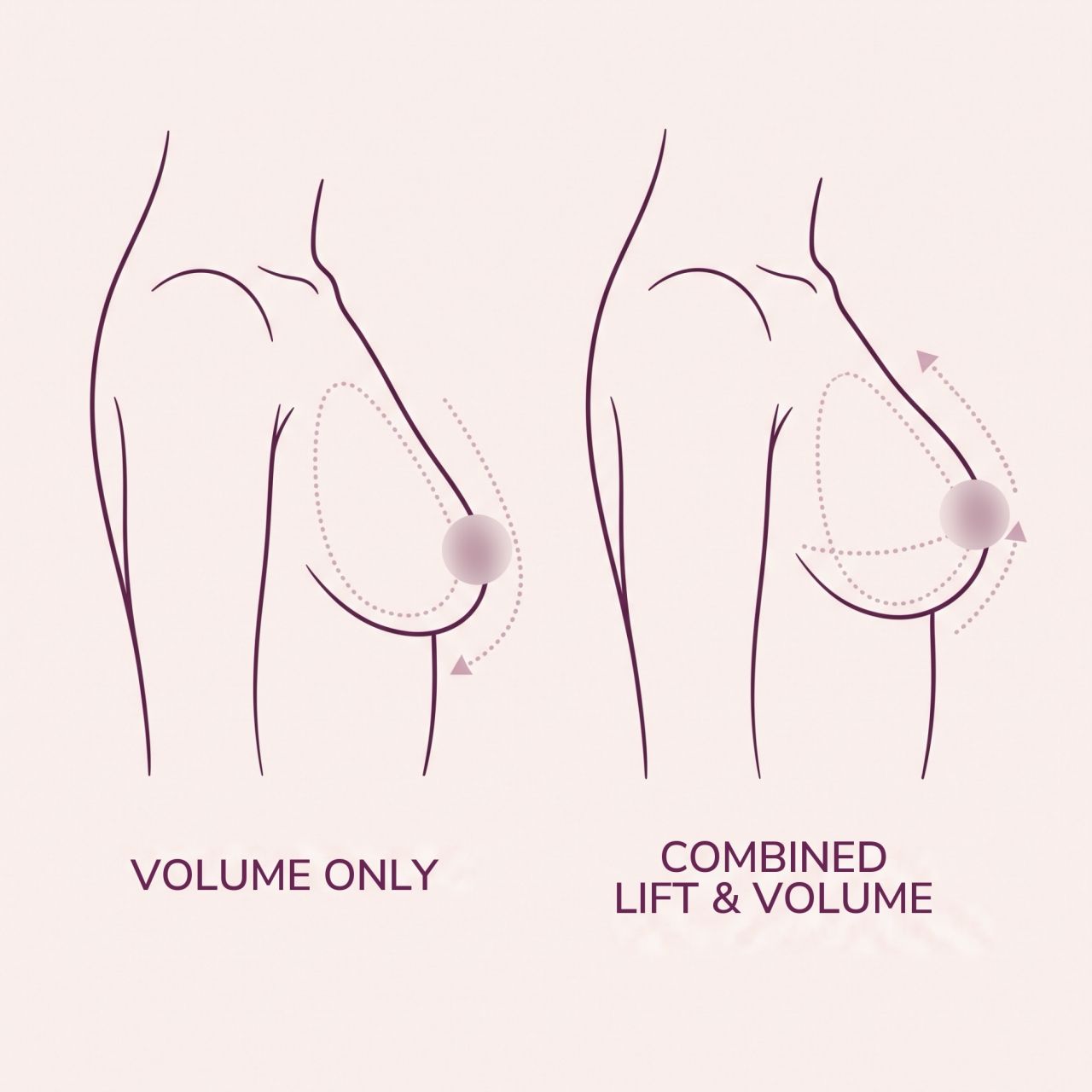
A substantial number of women need a lift and an implant together, and this deserves its own explanation because it is the most technically demanding option of the three.
The combination suits a breast that has both descended and emptied, which describes many women after breastfeeding. The lift repositions the tissue and the nipple. A modest implant restores the upper pole fullness that a lift alone cannot create, because a lift redistributes existing tissue and cannot add what is no longer there.
The reason it is demanding is that the two components work against each other. The implant pushes outward and increases tension on the skin envelope. The lift tightens that envelope and reduces it. Balancing those opposing forces in a single operation is harder than doing either alone, and augmentation mastopexy carries a higher revision rate than either procedure performed separately.
That is not a reason to avoid it. For the right breast it is the correct operation and it produces results neither component achieves alone. But you should know the revision rate is higher before you consent, and in some cases staging the two procedures across separate operations is the safer plan. A surgeon who raises staging is not hedging. They are managing a real technical problem.
The Question to Bring to Your Consultation
If you take one thing from this, let it be a change in what you ask.
Rather than asking for implants, or asking what size you should be, ask this: where does my nipple sit relative to my inframammary fold, and what does that mean for which operation I need?
A surgeon who can answer that immediately, and who shows you the measurement on your own body, is assessing you properly. A consultation that moves directly to implant sizing without establishing nipple position has skipped the step that determines everything.
You should also ask what your result will look like if you choose the lesser operation. If you want implants and your anatomy suggests a lift, ask directly what an implant alone will produce in your case. The answer should be specific to you rather than general reassurance.
Recovery, Briefly
An augmentation takes around one to two hours under general anaesthesia, usually a day case. A supportive bra for four to six weeks, desk work at around a week, no upper body exercise for six weeks.
A lift takes two to three hours and recovery is somewhat longer, with desk work realistic at around two weeks and the same six week restriction on upper body exertion. A combined augmentation mastopexy sits at the longer end of both.
Final shape settles over six to twelve months in all three. Scars mature over twelve to eighteen months and fade substantially, though they remain permanent.
On timing, the determining factor is your environment rather than the season. If you work and recover indoors in air conditioning, any month is workable. If your days involve outdoor activity, travel in the heat, or spaces without reliable cooling, wearing a supportive garment continuously through April to June is difficult and worth planning around.
Consultations in East of Kailash, South Delhi
We assess and plan breast lift, augmentation, and combined procedures at our clinic in East of Kailash, a short distance from Kailash Colony metro on the Violet Line, and easily reached from Greater Kailash I and II, Defence Colony, Lajpat Nagar, CR Park, Kalkaji, Jangpura, Nehru Place, and Sarita Vihar.
A female chaperone is present for every examination as routine. You do not need to arrive with a size in mind. The measurements come first, and they usually make the decision clearer than any amount of research beforehand.
Freyea Aesthetics
F-46, East of Kailash
New Delhi 110065, India
Dr. Ashutosh Misra, MCh (Plastic & Reconstructive Surgery), MS, MBBS
freyea.com